

Full Length Research Article
Effect of Ruellia tuberosa L. Leaves Extract on SGOT and SGPT Levels and Liver Histopathology in Alloxan-Induced Diabetes White Rats (Rattus norvegicus)
Tridiganita Intan Solikhah1*, Qurrotul Aini Dwi Agustin1, Ghulam Naufal Raffiuttaqi1, Syalzaesha Ainun Fatehah Pengestu1, Ragil Kusnandar Miftakhurrozaq2
Adv. life sci., vol. 12, no. 3, pp. 617-622, August 2025
*– Corresponding Author: Tridiganita Intan Solikhah (Email: tridiganita-intan-s@fkh.unair.ac.id)
Authors' Affiliations
2. Faculty of Medicine, Universitas Jember – Indonesia
[Date Received: 20/10/2024; Date Revised: 05/01/2025; Available Online: 31/10/2025]
Abstract
Introduction
Methods
Results
Discussion
References
Abstract
Background: Diabetes mellitus poses significant health risks, including liver damage, often caused by side effects of drug therapy. Ruellia tuberosa L. leaves, known for its antioxidant and antidiabetic properties, offers a promising natural alternative. This study evaluates its hepatoprotective potential by assessing Serum Glutamic Oxaloacetic Transaminase (SGOT) and Serum Glutamic Pyruvic Transaminase (SGPT) levels, along with liver histopathology in alloxan-induced diabetes white rats.
Methods: The research method used was a randomized posttest-only control group design. Alloxan was injected intraperitoneally with 150 mg/kg BW (single dose). Twenty-five male white rats were randomly divided into five groups: control group of diabetic white rats (K-), diabetic white rats given metformin (standard drug) dose of 50 mg/kg BW (K+), normal white rat control (P0), diabetic white rats given R. tuberosa leaves extract dose of 200 mg/kg BW (P1), and 400 mg/kg BW (P2). After 14 days, blood samples were analyzed for SGOT and SGPT levels, and liver tissues were examined histologically.
Results: The analysis showed that the administration of R. tuberosa leaves extract doses of 200 and 400 mg/kg BW in diabetic rats for 14 days had an improvement effect on SGOT, SGPT levels and histopathological images of liver organs.
Conclusion: R. tuberosa leaves extract, especially at the 400 mg/kg BW dose, can effectively lower SGOT and SGPT levels, also improving liver histopathology in diabetic rats. These findings suggest its potential as a complementary therapeutic option for liver complications in diabetic cases.
Keywords: Alloxan, Diabetes, Liver histopathology, SGOT, SGPT, Ruellia tuberosa L.
Introduction
Diabetes mellitus is a heterogeneous group of metabolic disorders characterized by chronic hyperglycemia. It is caused by impaired insulin secretion, various kinds of insulin resistance, or usually both [1,2]. Diabetes is a major health problem that has reached alarming levels. In 2019, nearly half a billion people lived with diabetes worldwide. This number is expected to increase to 578 million (10.2%) by 2030 and 700 million (10.9%) by 2045 [3]. Research from Liu et al. (2020) shows that diabetes mellitus remains a major public health problem globally [4].
Alloxan is known as pyrimidinetetrone, mesoxalylurea, mesoxalylcarbamide 2, 4, 5, and 6-tetraoxohexahydropyrimidine. The terms allantoin and oxaluric acid combined to create the name alloxan. The relative molecular mass of the compound is 142.06 and the chemical formula is C4H2N2O4 [5,6]. Alloxan is one of the first drugs in this class known to cause irreversible diabetes in animals [7]. Alloxan is a chemical compound commonly used to induce diabetes experimentally because it selectively destroys beta cells in the islets of Langerhans through sequential changes that cause apoptosis [8]. Alloxan administration can be done through intravenous, intramuscular, subcutaneous, or intraperitoneal routes [9].
Alloxan increases oxidative stress (ROS) which results in damage to pancreatic beta cells [10]. Alloxan is a toxic compound that causes diabetes, especially in pancreatic β-cells. The cytotoxic mechanism of alloxan is triggered by the entry of alloxan into pancreatic cells [11]. After entering pancreatic β-cells via the GLUT2 transporter, alloxan is reduced to dialuric acid in the cytosol by several cellular reducing agents [12]. Alloxan can form reactive oxygen species (ROS) in a cyclic reaction with its reduction product, dialuric acid [13]. Alloxan harms pancreatic β-cells by removing biological components that include sulfhydryl groups, proteins and enzymes connected to SH groups, also the amino acid cysteine [11].
Although most of the drugs for the treatment of diabetes mellitus have therapeutic benefits, most of them may cause unwanted side effects, hence the need for alternative treatments that have low side effects [14]. Herbal products have emerged as an important source of bioactive molecules for antidiabetic drug development [15]. Because they do not have significant side effects, plants are an attractive treatment alternative. Leaves are the most utilized part of the plant. Photosynthesis depends on leaves. Many phytochemical compounds found in leaves serve as a barrier from oxidation reactions as the leaves age. It is known that phytochemical compounds such as alkaloids, saponins, tannins, and flavonoids can be used as substitutes for antidiabetics and their complications [16].
R. tuberosa is one of the species of the Acanthaceae family or flowering plants. R. tuberosa is one of the medicinal plants that is widespread in the tropics. This plant grows abundantly in Asian countries, including Indonesia [17]. This plant is also widespread in the United States, Africa and Asia. R. tuberosa is often used as a traditional medicinal ingredient to cure diabetes in recent decades [18]. Some other parts can be used as traditional medicine that can treat various diseases and disorders such as lung problems, impaired kidney function, or sexually transmitted diseases [19].
The phytochemical content that has been known in R. tuberosa includes alkaloids, saponins, carotenoids, flavonoids, terpenoids, and tannins [17,20]. This content is believed to be used to overcome diarrhea, as an antidiabetic, antipyretic, antihypertensive, and analgesic, and to maintain kidney health [21]. Flavonoid compounds can repair damage to beta-pancreatic cells by increasing enzyme catalase. Flavonoid compounds in cells can reduce Reactive Oxygen Species (ROS) levels so that they can increase cell survival [22].
Research has shown that a crude ethanol extract and an ethyl acetate fraction of R. tuberosa leaves are a potential source of antioxidant compounds. These compounds may help prevent diabetes mellitus. Tests of R. tuberosa leaves in both in vivo and in vitro models revealed the presence of phenolic and flavonoid compounds. These can reduce oxidative stress, especially in diabetic patients [23].
Methods
Place and Time of Research
This study was conducted at the Faculty of Health, Medicine, and Life Sciences, Universitas Airlangga, located in Integrated Lab 6 during the adaptation period, treatment, and blood sampling of male white rats. Testing of blood serum levels was carried out at the Medical and X-ray Laboratory Wijaya Kusuma Mojokerto. The time span of this study was carried out in June – July 2024.
Research Tools and Materials
R. tuberosa leaves were used as the main experimental material in this study. This plant was obtained from Banyuwangi District, Banyuwangi Regency, East Java Province. The selection of R. tuberosa leaves was carried out purposively with the category of dark green leaves and leaf width ranging from 3-5 cm, without comparing with the same type of plant from other areas. The materials used in the study were male Wistar strain white rats weighing 180-200 grams, R. tuberosa leaves, food grade 96% ethanol, clean water, young corn, NaCl 0.9% (PT Otsuka Indonesia), Pokphand 593 Hi-Pro- Vite feed (CP593), 70% alcohol, distilled water, alloxan (PT Nitra Kimia), metformin (PT Hexpharm Jaya Laboratories), ketamine, sucrose, xylazine, and Carboxymethylcellulose (CMC).
Medical Ethics Test
This research, an ethical test was conducted to ensure that all actions and treatments provided to the experimental animals complied with the Standard Operating Procedures. This test was conducted at the Faculty of Dental Medicine, Universitas Airlangga, Campus C, Surabaya, under the reference number 0772/HRECC.FODM/VII/2024.
Research Methods
R. tuberosa leaves are cleaned from dirt by washing, then dried at room temperature (20-23°C) with good air circulation. The dried leaves were ground into simplicia powder using an electrical mill. The simplicia powder was poured with 96% ethanol solvent in a ratio of (1:1) for 3 x 24 hours, then the extract was filtered using Whatman filter paper. The entire solvent was removed at 80°C using a rotary evaporator at 120 rpm to produce a thick extract. Then the extract that has thickened is stored in a Beaker glass covered with aluminum foil for 5 days at -20°C to prevent damage to the extract [19].
Male white rats were divided into five groups, each consisting of five rats: a normal control group without treatment (P0), a negative control group (K−), two treatment groups (P1 and P2), and a positive control group (K+). The sample size (n = 5 per group) was determined based on ethical considerations and prior power analysis to minimize animal use while maintaining adequate statistical validity. Diabetes was induced by injecting alloxan (150 mg/kg BW, intraperitoneally) in all rat groups except the normal control group (P0). Alloxan was freshly dissolved in 0.9% NaCl solution before administration to ensure stability. The negative control group (K−) received only alloxan, whereas treatment groups P1 and P2 were administered Ruellia tuberosa leaf extract at doses of 200 and 400 mg/kg BW, respectively. The positive control group (K+) received metformin at a dose of 50 mg/kg BW. During the seven-day adaptation period, each rat was provided with 20 g of CP593 feed and 20 g of corn daily and given water ad libitum. Rats injected with alloxan were supplied with 10% sucrose solution to prevent severe hypoglycaemia. Blood glucose levels were measured via the tail vein three days after alloxan injection. Rats with fasting blood glucose levels ≥ 200 mg/dL were classified as diabetic and proceeded to the treatment phase. After confirmation of diabetes, R. tuberosa extract or metformin was administered orally for 14 days. On day 14, light anaesthesia was induced using xylazine and ketamine before blood was collected from the heart to measure SGOT and SGPT levels, followed by liver organ sampling for histopathological analysis.
Results
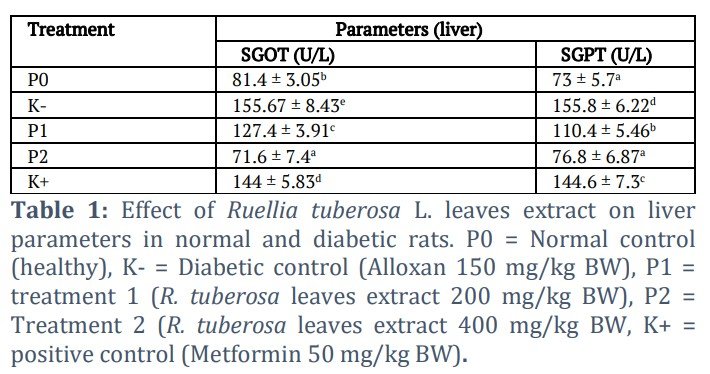
The results of the study of the administration of R. tuberosa leaves extract to the levels of SGOT, SGPT and liver histopathology of white rats (Rattus norvegicus) diabetes mellitus showed changes and differences in values and microscopic structures in 5 treatment groups. There are significant differences in SGOT levels between treatment groups. The highest average SGOT level was found in the negative control group (K-), which was 155.67 ± 8.43 U/L. The increase in SGOT levels is because rats in the negative control group (K-) were only induced with alloxan without being given R. tuberosa leaves extract or metformin. Based on Table 1, it is also known that there are significant differences in SGPT levels between treatment groups. SGPT levels were markedly elevated in the diabetic control group (K−) compared to the treated groups. The increase in SGPT levels is because rats in the negative control group (K-) were only induced with alloxan without being given R. tuberosa leaves extract or metformin.
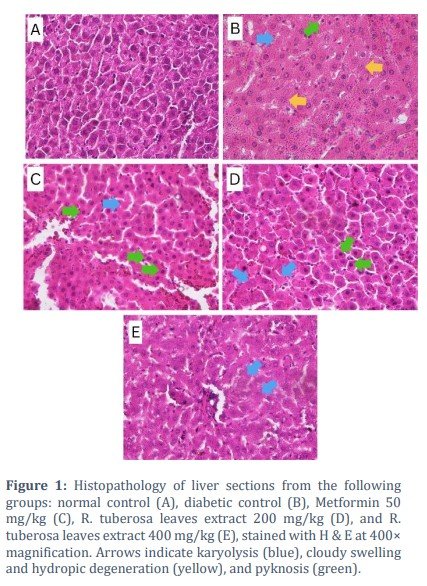
The normal control group showed no microscopic structural changes. In the negative treatment group, namely rats that were induced by alloxan, showed changes in the microscopic structure of liver cells, namely karyolysis. After checking blood sugar in the negative control group 5 days after alloxan induction showed levels of ≥200 mg/dL and checked for 14 days did not show a decrease in blood sugar so that the rats were positive for diabetes mellitus. Changes in microscopic structure in the form of hydropic degeneration (cloudy swelling), pyknosis necrosis and karyolysis. In the positive control group, namely rats that were induced with alloxan intraperitoneally and given metformin orally at a dose of 50 mg/kg BW, showed changes in the form of microscopic structures in the histopathological picture, namely, there was karyolysis and pyknosis. In group P1 rats induced with alloxan, given R. tuberosa leaves extract at a dose of 200 mg/kg BW orally for 14 days, a histopathological picture of microscopic structures was observed, including the presence of karyolysis, pyknosis, and necrosis. In group P2, rats induced by alloxan were given R. tuberosa leaves extract orally at a dose of 400 mg/kg BW for 14 days, showing an improvement. In group P2, liver cells showed no pyknosis, but mild karyolysis was still observed (Figure 1).
Figures & Tables
Type 1 diabetes was induced with alloxan. After five days of induction, blood glucose levels of Wistar white rats were measured with glucose test strips. Rats that had ≥ 200 mg/dL blood sugar of fasting were considered as diabetic and used in this study. R. tuberosa leaves extract was given to diabetic rats for 14 days without death perorally.
Alloxan is a substance that is often used as an induction of type 1 diabetes [24,25]. Alloxan causes hyposecretion of insulin by pancreatic beta cells because alloxan damages insulin-secreting pancreatic beta cells resulting in hyperglycemia [26,27]. Pancreatic beta cells successfully entered by alloxan will cause glucokinase activity to be inhibited and reactive oxygen species are produced, resulting in poor outcomes. High intracellular Ca2+ levels affect the release of high insulin levels [24]. From the first to the 14th day doses of R. tuberosa leaves were given 200 and 400 mg/kg BW. In all treatments, SGOT and SGPT levels decreased. The dose of 400 mg/kg BW was the most effective in reducing SGOT and SGPT levels, followed by the 200 mg/kg BW dose and metformin. However, in this study, metformin showed a lesser hepatoprotective effect than expected, which may be due to experimental variability, dosage differences, or possible interactions with alloxan-induced hepatic stress. SGOT and SGPT are a group of aminotransferase enzymes that have a role as indicators of damage to hepatocyte cells, with damage to hepatocyte cells there will be an increase in SGPT and SGOT [28]. Interestingly, the SGOT level in the P2 group (71.6 ± 7.4 U/L) was significantly lower than that of the normal control (81.4 ± 3.05 U/L). While the study interpreted this as an improvement, this finding warrants cautious interpretation. A reduction of serum transaminase activity below the physiological range of healthy rats may reflect either experimental variation, assay interference by phytochemicals, or a dose-dependent suppressive effect on hepatic enzyme synthesis or release. Future studies should examine whether this apparent over-reduction in SGOT represents a true hepatoprotective response or an unintended biochemical alteration. In this study, the increase in SGPT will be followed by an increase in SGOT, this states that the injection of alloxan 150 mg/kg BW can affect damage to liver cells. Steroids, flavonoids, phenolics, and ascorbic acids are contained in R. tuberosa leaves extract [17]. These compounds can help repair damage to liver cells, which may lead to a reduction in SGPT and SGOT levels. In the treatment of R. tuberosa leaves extract at a dose of 400mg/kg BW, SGOT and SGPT levels decreased, this can be caused by the higher the dose given, the more content contained in R. tuberosa leaves extract so that the effectiveness given to repair damage to liver cells is higher, but in this treatment, karyolysis is still found in liver cells. In the treatment of R. tuberosa leaves extract at a dose of 200mg/kg BW reduced SGOT and SGPT levels but there was still damage to hepatocyte cells in the form of karyolysis and pyknosis which indicates that the dose is still not effective in reducing SGOT and SGPT levels. Giving R. tuberosa leaves extract can help the performance of liver enzymes, such as SGOT and SGPT in the process of repairing damaged hepatocyte cells and R. tuberosa leaves extract has content that can increase the survival of liver cells.
The main pathophysiological effect of alloxan, due to its thiol reactivity, is the selective inhibition of insulin secretion which can lead to pancreatic β-cells damage. This disruption can affect glucose uptake into cells, thus resulting in elevated blood glucose levels [29]. Oxidative stress across multiple organs, such as the liver, heart, brain, and skeletal muscles can be triggered under hyperglycemia condition. Metabolic alterations in lipids, proteins, and enzymes can also be promoted under oxidative stress, which can potentially cause oxidative damage. If left uncontrolled, the damage can eventually lead to liver injury. The liver functions in the process of biotransformation and detoxification of endogenous and exogenous substances that enter the body and functions to filter blood from various organs containing food, drugs, toxins, and bacteria. Diabetes mellitus will affect the occurrence of changes in cell morphology in the liver [30].
Based on descriptive analysis of liver histopathology results, it shows that the occurrence of degeneration in the diabetic control group is due to intracellular biochemical alterations, accompanied by morphological changes. These changes were associated with nonfatal cellular lesions or adaptive responses to reversible damage which often involving fluid accumulation or the buildup of other substances within cell organelles. However, in other treatments, no degeneration was found but necrosis (pyknosis and karyolysis) was still found. Necrosis develops when tissues are exposed to hypoxic conditions or exposed to toxic foreign bodies. The P2 group, treated with an R. tuberosa dose of 400 mg/kg BW, showed less damage compared to other treatments, namely only karyolysis occurred. This means that R. tuberosa leaves at a dose of 400 mg/kg BW can be an alternative therapy to improve the histopathological picture of alloxan-induced liver. Recent research reports that R. tuberosa leaves have high antioxidant activity in diabetics including saponins, carotenoids, flavonoids and phenols so that they can reduce oxidative stress and have effective anti-inflammatory in cases of diabetes [31].
The metformin-treated group (K+) had higher SGOT and SGPT levels than the normal or healthy control group (P0). When compared to the negative or diabetic control group (K-), the metformin-treated group showed only a slight reduction in SGOT and SGPT levels. The negative control (K-) group had SGOT and SGPT levels of 155.67 ± 8.43e and 155.8 ± 6.22d while the metformin-treated group (K+) had levels of 144 ± 5.83d and 144.6 ± 7.3c. These results are unexpected because metformin is generally reported to have hepatoprotective or neutral effects in experimental diabetes models [32, 33]. Consistently, histopathological examination of the K+ group also revealed degenerative and necrotic changes, including karyolysis and pyknosis which indicate possible hepatic stress. In contrast, administration of R. tuberosa leaf extract resulted lower SGOT and SGPT levels and showed fewer histopathological changes, suggesting that the extract provided a more favorable hepatoprotective effect than metformin in this research.
Based on the results of the research that has been done, the conclusion that can be drawn is that the administration of R. tuberosa leaves extract to white rats induced diabetes model using alloxan for 14 days shows an effect on SGOT, SGPT levels and histopathological images of liver organs. SGOT and SGPT levels of R. tuberosa leaves extract treatment groups at doses of 200 and 400 mg/kg BW decreased, and for the histopathology picture of the R. tuberosa leaves extract treatment group at a dose of 400 mg/kg BW experienced improvements compared to other treatment groups. The dose of R. tuberosa leaves extract 400 mg/kg BW is the most effective dose that can be used in diabetes mellitus therapy.
Acknowledgments
The authors are thankful to Universitas Airlangga for providing the necessary facilities for this study. This study was supported by Airlangga Research Fund, Universitas Airlangga, Indonesia (grant number 627/UN3/2024).
Author Contributions
- Schleicher E, Gerdes C, Petersmann A, Müller-Wieland D, Müller UA, Freckmann G, et al. Definition, classification and diagnosis of diabetes mellitus 1. Experimental and Clinical Endocrinology & Diabetes, (2022); 130(S01): S1-S8.
- Luo Z, Fu C, Li T, Gao Q, Miao D, Xu J, et al. Hypoglycemic effects of licochalcone A on the streptozotocin-induced diabetic mice and its mechanism study. Journal of Agricultural and Food Chemistry, (2021); 69(8): 2444–2456.
- Saeedi P, Petersohn I, Salpea P, Malanda B, Karuranga S, Unwin N, et al. Global and regional diabetes prevalence estimates for 2019 and projections for 2030 and 2045: Results from the International Diabetes Federation Diabetes Atlas, 9th edition. Diabetes Research and Clinical Practice, (2019); 157: 107843.
- Liu J, Ren ZH, Qiang H, Wu J, Shen M, Zhang L, et al. Trends in the incidence of diabetes mellitus: results from the global burden of disease study 2017 and implications for diabetes mellitus prevention. BMC Public Health, (2020); 20(1): 1–12.
- Pansera K, Upasani C, Upangalwar A, Sonawane G, Patil C. Streptozotocin and alloxan induced diabetic nephropathy: protective role of natural products. Journal of the Maharaja Sayajirao University of Baroda, (2021); 55(1): 86–102.
- Veeranjaneyulu C, Subrahmanyam G. Rediscovered the induction of diabetogenic agents in the experimental animal model: review. International Journal of Applied Biology and Pharmaceutical Technology, (2016); 7(3): 95–104.
- Maqbool M, Dar MA, Gani I, Mir SA. Animal models in diabetes mellitus : An overview. Journal of Drug Delivery and Therapeutics, (2019); 9(1-s): 472–475.
- Sheriff OL, Olayemi O, Taofeeq AO, Riskat KE, Ojochebo DE, Ibukunoluwa AO. A new model for alloxan-induced diabetes mellitus in rats. Journal of Bangladesh Society of Physiologist, (2020); 14(2): 56–62.
- Martín-Carro B, Donate-Correa J, Fernández-Villabrille S, Martín-Vírgala J, Panizo S, et al. Experimental models to study diabetes mellitus and its complications: limitations and new opportunities. International journal of molecular sciences, (2023); 24(12):10309.
- Li W, Lin K, Zhou M, Xiong Q, Li C, Ru Q. Polysaccharides from Opuntia milpa alta alleviate alloxan-induced INS-1 cells apoptosis via reducing oxidative stress and upregulating Nrf2 expression. Nutrition Research, (2020); 77: 108–118.
- Solikhah TI, Solikhah GP. Effect of Muntingia calabura L. leaf extract on blood glucose levels and body weight of alloxan-induced diabetic mice. Pharmacognosy Journal, (2021); 13(6): 1450–1455.
- Dra LA, Sellami S, Rais H, Aziz F, Aghraz A, Bekkouche K, et al. Antidiabetic potential of Caralluma europaea against alloxan-induced diabetes in mice. Saudi Journal of Biological Sciences, (2019); 26(6): 1171–1178.
- Pansare K, Sonawane G, Mahajan T, Khairnar S, Patil C, Andhale A. Protective role Of natural products in alloxan and streptozotocin induced diabetic nephropathy: A concise review. Natural Volatiles Essential Oils, (2021); 8(6): 3977–3994.
- Feng J, Wang X, Xiaochun Ye, Ares I, Lopez-Torres B, Martínez M, et al. Mitochondria as an important target of metformin: The mechanism of action, toxic and side effects, and new therapeutic applications. Pharmacological Research, (2022); 177: 106114.
- Rahman MM, Islam MR, Shohag S, Hossain ME, Rahaman MS, Islam F, et al. The multifunctional role of herbal products in the management of diabetes and obesity: A comprehensive review. Molecules, (2022); 27(5): 1713.
- Alam S, Sarker MMR, Sultana TN, Chowdhury MNR, Rashid MA, Chaity NI, et al. Antidiabetic phytochemicals from medicinal plants: prospective candidates for new drug discovery and development. Frontiers in Endocrinology, (2022); 13: 800714.
- Safitri A, Fatchiyah F, Sari DRT, Roosdiana A. Phytochemical screening, in vitro anti-oxidant activity, and in silico anti-diabetic activity of aqueous extracts of Ruellia tuberosa L. Journal of Applied Pharmaceutical Science, (2020); 10(3): 101–108.
- Xu JH, Lo YM, Chang WC, Huang DW, Wu JSB, Jhang YY, et al. Identification of bioactive components from Ruellia tuberosa L. on improving glucose uptake in TNF‐α‐induced insulin‐resistant mouse FL83B hepatocytes. Evidence-Based Complementary and Alternative Medicine, (2020); 2020(1): 6644253.
- Guha S, Talukdar D, Mandal GK, Mukherjee R, Ghosh S, Naskar R, et al. Crude extract of Ruellia tuberosa L . flower induces intracellular ROS , promotes DNA damage and apoptosis in triple negative breast cancer cells. Journal of Ethnopharmacology, (2024); 332: 118389.
- Ramadhan M, Sabarudin A, Safitri A. In vitro anti-microbial activity of hydroethanolic extracts of Ruellia tuberosa L.: eco-friendly based-product against selected pathogenic bacteria. IOP Conference Series: Earth and Environmental Science, (2019); 239: 012028.
- Dutta S, Hazra K, Ghosal S, Paria D, Hazra J, Rao MM. Morpho-anatomical and phytochemical characterisation of traditionally used plant Ruellia tuberosa L. leaves and roots. International Journal of Pharmacognosy, (2020); 7(1): 12–22.
- Solikhah TI, Setiawan B, Ismukada DR. Antidiabetic activity of papaya leaf extract (Carica papaya L.) isolated with maceration method in alloxan-induces diabetic mice. Systematic Reviews in Pharmacy, (2020); 11(9): 774–778.
- Ladeska V, Anggia V, Priyanto, Mentari I, Inas U, Permatasari DL, et al. Phytochemical, antioxidant studies of Ruellia tuberosa Linn, heart, and lung organs. Arabian Journal of Medicinal & Aromatic Plants, (2023); 9(3): 74–90.
- Solikhah TI, Miftakhurrozaq RK, Khairullah AR. Antidiabetic activity and pancreatic histopathology analysis of Averrhoa bilimbi L. leaves extract on alloxan-induced diabetes on wistar mice. Advancements in Life Sciences, (2024); 11(3): 669–673.
- Solikhah TI, Rani CA, Septiani M, Putra YA, Rachmah Q, Solikhah GP. Antidiabetic of Hylocereus polyrhizus peel ethanolic extract on alloxan induced diabetic mice. Iraqi Journal of Veterinary Sciences, (2022); 36(3): 797–802.
- Khalaf SJ, Aljader GH, Sarhat ER, Sarhat TR, Abass KS. Antidiabetic effect of aqueous extract of Medicago Sativa with enhanced histopathology of pancreas in alloxan induced diabetic rats. Pakistan Journal of Medical and Health Sciences, (2021); 15(2): 492–496.
- Solikhah TI, Wijaya TA, Pavita DA, Kusnandar R, Wijaya A, Raharjo HM, et al. The effect of sapodilla leaf extract (Manilkara zapota L.) on lipid profiles of alloxan-induced diabetic mice. Pharmacognosy Journal, (2023); 15(2): 286–289.
- Bari MW, Islam MM, Khatun M, Sultana MJ, Ahmed R, Islam A, et al. Antidiabetic effect of wedelia chinensis leaf extract in alloxan induced swiss albino diabetic mice. Clinical Phytoscience, (2020); 6: 58.
- Longkumer S, Jamir A, Kechu M, Ezung S, Prankaj PP. Alloxan monohydrate induced diabetes: A comprehensive review. International Journal of Innovative Life Sciences, (2021); 1(1): 6–14.
- Suputri NKAW, Azmijah A, Bijanti R, Putra MM. Effects of onion extract on hepar histopatology in alloxan-induced diabetic rattus novergicus. Medico-Legal Update, (2020); 20(3): 384–390.
- Pham TNT, Nguyen TT, Nguyen TLT, Tran AMN, Nguyen TN, Tong DT, et al. Antioxidant and anti-inflammatory activities of phytochemicals from Ruellia tuberosa. Journal of Chemistry, (2022); 2022: 1–14.
- Cozma GV, Apostu A, Macasoi I, Dehelean CA, Cretu OM, Dinu S, et al. In Vitro and In Ovo Evaluation of the Potential Hepatoprotective Effect of Metformin. Medicina, (2022); 58(6): 705.
- Iranshahy M, Rezaee R, Karimi G. Hepatoprotective activity of metformin: a new mission for an old drug?. European journal of pharmacology, (2019); 850: 1-7.
This work is licensed under a Creative Commons Attribution-Non Commercial 4.0 International License. To read the copy of this license please visit: https://creativecommons.org/licenses/by-nc/4.0