

Full Length Research Article
Sainfoin (Onobrychis arenaria) Productivity Depending on Organic and Mineral Fertilizers
Matvey Yakovlev*, Andrey Petrov, Ivan Lavrishchev, Ivan Karkhardin, Anna Pastukhova
Adv. life sci., vol. 11, no. 1, pp. 77-83, February 2024
*– Corresponding Author: Matvey Yakovlev (mayakovlev@hotmail.com)
Authors' Affiliations
[Date Received: 16/10/2022; Date Revised: 27/12/2023; Date Published: 25/02/2024]
Abstract
Introduction
Methods
Results
Discussion
References
Abstract
Background: Numerous experiments in Russia and abroad indicate that the productivity of natural hayfields and pastures is high enough only if legumes are present in the herbage. It is also of great importance to increase their productivity by applying mineral fertilizers, which often define the final productivity of the herbage. To determine the effect of organic and mineral fertilizers on the productivity of sainfoin.
Methods: The main method used in the study was a field experiment combined with laboratory analysis. Measurements of plant density were carried out in the spring before each harvesting of cover crops and sainfoin. In the course of the study, phenological and morphological observations, accounting, and evaluation of the quality of sainfoin were carried out. The structure of the herbage was evaluated according to the following indicators: plant density, plant height, leafiness, and the area of the assimilation surface of grasses. Measurements were carried out in spring before each harvesting of grasses. Height measurements were based on the phases of plant development.
Results: Final yield data show that fertilizers have a significant impact. Thus, the yield of sainfoin and cover crops in 2019 (in the first year of the experiment) was: 4.7 t/ha for variant 8 and 4.5 t/ha for the control variant. In 2020 and 2021, the yield of experimental variant 8 exceeded that of the control variant. Statistical processing of the results of the experiment confirms the positive effect of fertilizers on the yield.
Conclusions: The best results were achieved with the use of 30 t/ha of organic fertilizers + N60 P60 K40.
Keywords: Sainfoin; Organic Fertilizers; Mineral Fertilizers; Yield, Survival
Introduction
To further develop animal husbandry and increase the productivity of farm animals, it is necessary to create a solid food base in all regions of the country. Each feed unit should account for up to 110 g of digested protein in a complete diet. The lack of protein leads to incomplete use of a significant part of the feed the farm animals receive in silage, meadow hay, and straw [1-3]. With unilateral feeding, their health deteriorates, and productivity decreases. Prolonged protein deficiency leads to metabolic disorders and some gastrointestinal diseases. It is economically unprofitable to compensate for the missing amount of feed protein by increasing the supply of concentrates [4]. Therefore, it is very important to increase the production of green mass and legume hay, the source of the cheapest vegetable protein [5].
Numerous experiments in our country and abroad indicate that the productivity of natural hayfields and pastures is high enough only if legumes are present in the herbage [6-9]. They provide feed with a protein content of up to 17-20% per dry matter weight. Legumes have the most significant amount of nutrients during budding and a higher yield of feed mass with the highest content of digested protein during blooming [10, 11]. In addition, there is a lot of phosphorus, calcium, vitamins, and especially carotene in legume-based feed. Young greens of legumes are nutritionally superior to concentrated feeds. The young green legume grass contains 5.7-6.7% of digested protein, i.e. 2.5-3 times more than in grains. Perennial leguminous grasses have the nitrogen-fixing ability, which is provided by the symbiosis of their roots with nodule bacteria that assimilate nitrogen from the air [12-14]. The high nitrogen-fixing ability of legumes is of great importance in feed production and agriculture in general. In two years, they accumulate in the aboveground part and the roots from 130 to 200 kg/ha of nitrogen, 20-50 kg of phosphorus, and 80-150 kg of potassium. Leguminous grasses included in field and meadow grass mixtures significantly improve the physicochemical and agrochemical parameters of soils [7].
The experiment aimed to determine the effect of organic and mineral fertilizers on the productivity of sainfoin.
Methods
Experimental Design
The method of the study was field experiments in combination with laboratory analysis. The study was carried out in 2019-2021 in the northern part of the forest-steppe of Western Siberia on the fields of the Praktik educational and experimental farm of the Novosibirsk State Agrarian University.
Experimental Scheme
The laying experiment was established and carried out according to the methodology developed by Dospekhov [15]. To study the productivity of perennial grasses with the use of various types of fertilizers, it was developed the following experiment scheme:
- Control variant (no fertilizers)
- N60P60K40
- 10 t/ha of organic fertilizers (manure)
- 10 t/ha of organic fertilizers (manure) + N60P60K40
- 20 t/ha of organic fertilizers (manure)
- 20 t/ha of organic fertilizers (manure) + N60P60K40
- 30 t/ha of organic fertilizers (manure)
- 30 t/ha of organic fertilizers (manure) + N60P60K40
In subsequent years, mineral fertilizers were applied annually in the spring, and organic fertilizers were applied on a one–time basis for five years. The experimental plot area was 20 m2, the area of the registration plot was 10 m2, the repetition was fourfold, and the location was randomized.
Climate and Weather Conditions
The climate of the Novosibirsk region is characterized by pronounced continentality with long winters and short but hot, often dry summers.
In 2019, the average monthly temperature in May and June did not deviate from the average annual data. May 2020 and 2021 were characterized by unstable weather with significant fluctuations. The temperature was 4.6 °C in 2020 and 2021 by 3.3 °C above the average long-term data. In June, moderately warm weather was 0.3°C and 0.7°C below the normal one. July 2020 and 2021 had warm weather, 1-2°C above normal, while July 2019 was moderately warm by 0.2 °C below the average annual temperature. In August, the temperature was higher than the annual average in all three years (1.9; 2.2; 2.5). In September 2019 and 2020, the temperature was higher than the annual average by 1°C, and in 2021 it was lower by 0.6 °C.
In 2019, precipitation in May, July, and September was higher than the average annual values, and in June and August, it was lower. In 2020, in the period from May to September, precipitation was higher than normal by an average of 42%. Only the month of June was different, where precipitation was less than normal by 56%. 2021 differed from the previous years and was characterized by a small amount of precipitation throughout the growing season, with only 31% more than normal in June. A temperature of +18-20 °C and enough precipitation are required to form a good harvest. The years 2019 and 2020 were well provided with precipitation, so a good harvest was formed in those years, and the drought of 2021 did not allow the harvest of sainfoin and other herbs to be formed.
In Siberia, Hungarian sainfoin has become widespread. This perennial legume crop is quite common in its pure form. It is grown in steppe and forest-steppe areas, where it occupies about 15% of the area of sowing perennial grasses [8].
Plant Material and Experimental Procedure
The SIBNIIK41 sainfoin variety was selected for the study. The experiment was established on June 3, 2019, with the cover culture of millet Baganskoe 88 seeds of the first reproduction. The depth of planting millet seeds was 3-4 cm and 2-3 cm for sainfoin. Organic and mineral fertilizers were introduced into the soil before sowing. The shoots of the sainfoin appeared 6 days after sowing, and the shoots of the cover culture 11 days after sowing. Field germination was 70% for millet and 75% for sainfoin. The measurements were carried out over three years of the experiment. The structure of the herbage was evaluated according to the following indicators: plant density, plant height, leafiness, and the area of the assimilation surface of grasses. Measurements were carried out in spring before each harvesting of grasses. Height measurements were based on the phases of plant development.
Data Analysis
The collected data were subjected to statistical analysis to assess the effects of the different fertilization treatments on various plant parameters. This analysis helped determine the significance of fertilizer impact on the growth and productivity of sainfoin.
Results
In the first year of observations (2019), the density of millet and sainfoin was measured, and in subsequent years only the density of sainfoin, during the first and second harvesting. In the first year, the plant density of the cover culture and the sainfoin was higher in the fertilized areas. The number of sainfoin stems per unit area in August, during the phase of wax ripeness of millet grain was 171 pcs/m2 in variant 1 (control) and 204 pcs/m2 in variant 8 (30 t/ha of organic fertilizers (manure) + N30P30K50). The millet stem density was 323 and 336 pcs/m2, respectively.
In 2020, the number of sainfoin stems per unit area before the first cutting was 76 pcs/m2 on variant 1 (control) and 92 pcs/m2 on variant 8 (30 t/ha of organic fertilizers (manure) + N30P30K50).
In the third year (2021)the indicators were affected by poor meteorological conditions. In particular, the lack of the necessary amount of precipitation, the number of sainfoin stems per unit area before the first harvest was 32 pcs/m² on variant 1 (control). In variant 8 (30 t/ha of organic fertilizers (manure) + N30P30K50) it equaled 49 pcs/m2 (Table 1).
Observations of the stem height in 2019 showed a significant effect of organic and mineral fertilizers on plant height (Table 2). The average height of millet in the control variant was 87.4 cm, and in variant 8, it was 96.3 cm. In 2020, the average height of sainfoin before cutting in variant 1 was 78.1 cm, and in variant 8, it was 100 cm. In the third year (2021) of observations, the stem height indicators were similar: 85.2 cm in variant 1 and 94 cm in variant 8.
It should be mentioned that plant height, and density are the indicators on which the yield depends. Based on the data on plant height, a daily increase was determined. In the first year, it was determined on the plants of the cover culture. Observations were carried out only on sainfoin plants (Table 3). The influence of organic and mineral fertilizers is very significant here: the maximum daily increase was noted in the tillering phase of millet in variant 8 (2.9 cm), while in the control variant, this indicator equaled 2.4 cm. The increase became less pronounced by the next phase (ear emergence), equaling 2.6 and 2.1 cm, respectively, in the variants under consideration. By the phase of wax ripeness of grain, the increase became even less pronounced and did not exceed 1.7 and 1.5, respectively.
The growth of the sainfoin in the first year of the experiment was expectedly lower, its largest value in the branching phase equaling 1.2 cm in variant 8 and 1.1 cm in the control variant during the same period. However, the maximum growth of the sainfoin was noted in 2020 (the second year), amounting to 1.9 cm in the branching phase and 2.1 cm in the budding phase. In 2021, a significant effect of fertilizers on the daily growth of the sainfoin was noted. The main cutting was 1.7 cm in variant 8 and 0.8 cm in the control variant. As for the plant leafiness during the years of the experiments was as follows (Table 4).
The highest leafiness index was recorded in the first year of life (36-45%), with no significant effect of fertilizers on this indicator noted in the first year. The leafiness of millet during this period was noticeably lower (13-15%). Consequently, in the first year, the leafiness of the sainfoin was the highest, which affected its nutritional value. The leaves contain the main nutrients, and their content in the leaves is much higher compared to the stems. In the second and third years, the leafiness of the sainfoin did not exceed 32-39%. Millet leafiness (second harvest): 43-51%. The leafiness affected the size of the leaf area (Table 4).
The greatest effect of fertilizers was noted in millet in variant 8. Moreover, the leaf surface index increase can be traced according to the variants, where it equaled 2.3 in the control variant and 4 in variant 8 (Table 5). The sainfoin leaf surface index was quite high, reaching 27.7 ha/ha. In the following years, this indicator decreased in the first cutting, its value not exceeding 3.8 ha/ha, and in the second cutting, it equaled 3.9 ha/ha. The optimal value of the grass leaf surface index was 3. Consequently, in our conditions, the sainfoin reached the optimal value of its development.
Yield data indicate that fertilizers have a significant impact (Table 6). The yield of the sainfoin and the cover crop in 2019 (in the first year of life) was 4.7 t/ha for variant 8 and 4.5 t/ha for the control variant. In 2020 and 2021, the yield of experimental variant 8 exceeded that of the control variant. Statistical processing of the experiment results confirms the positive effect of fertilizers on the yield.
The positive effect of organic and mineral fertilizers on the yield index was also noted (Table 7).
In the first year, the productivity of sainfoin and millet was highest in variant 7 (30 t/ha of organic fertilizers) and amounted to 2.9 t/ha of feed units and 0.18 t/ha of digested protein. On the contrary, the control variant had the lowest productivity of 1.6 t/ha and 0.07 t/ha, respectively. The positive effect of fertilizers was monitored for three years of the experiment.
Figures & Tables

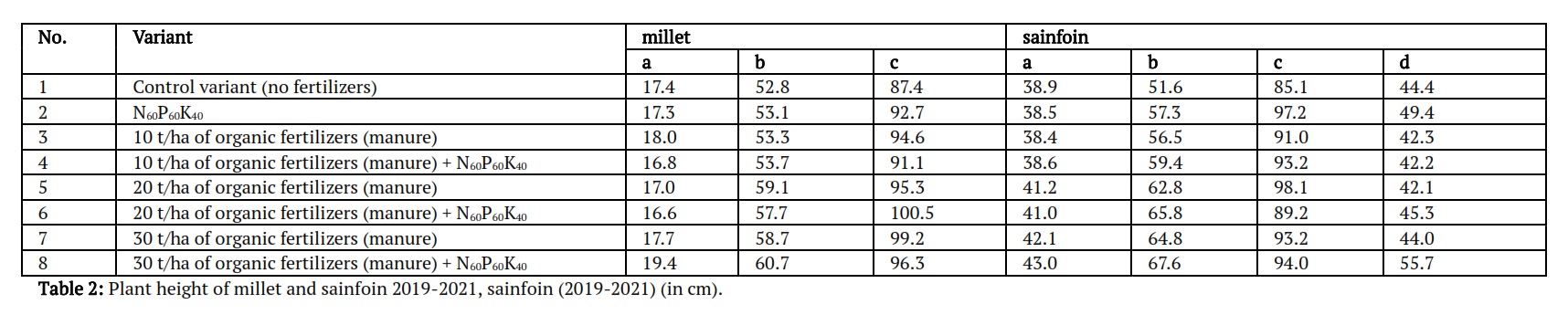
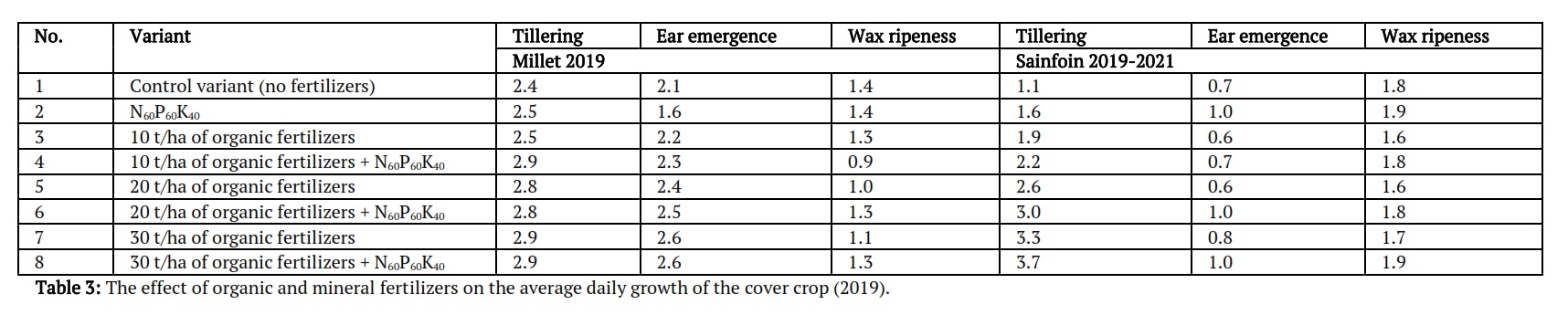



The results of our study shed light on the significant impact of mineral and organic fertilizers on the productivity of sainfoin. Through a comprehensive three-year investigation, we explored the effects of various fertilization schemes on key growth parameters of sainfoin. Specifically, we observed that the application of 30 t/ha of organic fertilizers in combination with N60P60K40 positively influenced sainfoin stem density over the course of three years. Moreover, our findings indicate that the use of 30 t/ha of organic fertilizers + N60P60K40 led to favorable outcomes in terms of overall crop growth and development. This treatment exhibited the highest plant height and average daily growth rate, particularly in variant 8. These results suggest that the combination of organic and mineral fertilizers can effectively promote the growth of sainfoin plants, potentially enhancing their capacity to contribute to livestock feed. Another notable aspect of our study is the evaluation of the leaf surface index, a critical indicator of vegetation vigor. In line with our expectations, the application of organic and mineral fertilizers had a positive impact on this index, with the most significant gains observed in variant 8. This underscores the importance of balanced nutrient supplementation in optimizing the growth and biomass production of sainfoin. Our findings are consistent with existing research that emphasizes the positive effects of fertilizers on forage crop productivity [16]. Studies conducted in various regions have consistently demonstrated that appropriate fertilization can enhance the nutritional content of feed [17], ultimately contributing to improved livestock health and performance [18]. The similarities between our results and those of previous studies underscore the universal relevance of nutrient management strategies in agricultural practices [19].
Furthermore, the implications of our research extend beyond crop productivity, reaching into the realm of sustainable agricultural practices. The concept of biologization, which involves the utilization of agrotechnical techniques and natural mechanisms to enhance soil fertility, resonates with our findings [20]. By employing a combination of organic and mineral fertilizers, we not only witnessed increased sainfoin yields but also contributed to the activation of natural nutrient cycling processes within the soil [21]. This aligns with global efforts to promote eco-friendly and economically viable approaches to agriculture [22]. In conclusion, we note that the introduction of organic fertilizers helps to increase the productivity of the cover crop and the sainfoin. The highest productivity was noted in the variant where 30 t/ha of organic fertilizers were applied with mineral fertilizers. Experiments conducted in other localities also show positive dynamics of the increase in the yield of green mass, the accumulation of crude protein in the green mass, and biological nitrogen in the soil. For example, in the Republic of North Ossetia, when N30P30K30 is applied to the soil, in the form of ammonium nitrate phosphate fertilizer and top dressing, by spraying with a backpack sprayer. The yield increased by 0.7-5.6 t/ha, and the protein content by 0.4-1.8% [23]. In the Belgorod region, the use of fertilizers contributed to the more rational use of soil moisture by plants. It also increased productivity, leaf surface index, and the growth of the main crop [24]. Experiments in France also showed an increase in the main agrotechnical indicators of sainfoin against the background of the use of organic fertilizers.
In this study, we examined the impact of organic and mineral fertilizers on the productivity of sainfoin, a leguminous crop widely recognized for its role in enhancing livestock nutrition. Our findings revealed significant positive effects of fertilization on various growth and yield parameters of sainfoin. Acknowledging the limitations of our study, it is essential to recognize that the research was conducted in a specific geographical region and under specific climatic conditions. As such, the results might exhibit variability when applied to different environments. Moreover, factors such as soil type, nutrient availability, and management practices could influence the response of sainfoin to fertilization, warranting further investigation. Future research efforts could delve into the exploration of optimal fertilization rates, timing, and methods for sainfoin cultivation in diverse agroecosystems. Comparative studies across various regions and climates could provide a more comprehensive understanding of sainfoin's response to fertilization under different conditions. Additionally, investigating the long-term effects of fertilization on soil health and microbial communities could offer valuable insights into the sustainability of such practices. The implications of our research extend beyond the academic realm and hold practical significance for farmers, livestock producers, and policymakers. The cultivation of sainfoin with the optimized use of organic and mineral fertilizers can significantly enhance the quality of livestock feed. Sainfoin's high protein content, particularly during budding and blooming phases, provides a valuable source of nutritious forage for animals. The increased yield and improved leafiness resulting from fertilization contribute to higher protein intake, potentially reducing the need for expensive concentrated feeds.
Conflict of Interest
The authors declare that there is no conflict of interest.
All authors of this study contributed collaboratively and equally to various aspects of the manuscript preparation such as conceptualization, data collection and analysis, critical review and editing and final approval.
References
- Belchenko SA, Torikov VE, Dronov AV, Belous IN, Bychkova KYu. Organization of a meadow management system based on the combined use of herbage. Vestnik FGOU VPO Bryanskaya GSKhA, (2015); 5(51): 8-14.
- Bents VA, Kashevarov NI, Demarchuk GA. Field fodder production in Siberia. Novosibirsk, Russia: RASKhN. Sib. otd-nie. SibNII kormov, 2001.
- Nasiyev BN, Bekkaliyeva AK, Vassilina TK, Shibaikin VA, Zhylkybay AM. Biologized Technologies for Cultivation of Field Crops in the Organic Farming System of West Kazakhstan. Journal of Ecological Engineering, (2022); 23(8): 77-88.
- Shevko VM, Karataeva GE, Badikova AD, Tuleev MA, Uteeva RA. Comprehensive processing of basalt together with magnetite concentrate in order to obtain ferrous alloy and calcium carbide. Archives of Foundry Engineering, (2020); 20(4): 41–54.
- Chernyavskii AN. Methods of soil treatment and doses of fertilizers when growing sainfoin in crop rotation in the southwestern part of the Central Chernozem zone: Abstract dis.… cand. agricultural sciences. Belgorod State Agricultural Academy, Belgorod, Russia, 2007.
- Nikulin AB. Efficiency of cultivation of legume and legume and grass herbage with fodder galega in the Leningrad Region. Izvestiya SPbGAU, (2015); 41: 21-24.
- Rail LF. Common (Alpine) practices on the use of public pastures in Highland Kyrgyzstan and Central Europe. McGill University, Canada, 2020.
- Shamsutdinov ZSh. Forage crop selection: Achievements and challenges. Selskokhozyaistvennaya biologiya, (2014); 6: 36-45.
- Haider LJ, Boonstra WJ, Akobirshoeva A, Schlüter M. Effects of development interventions on biocultural diversity: A case study from the Pamir Mountains. Agriculture and Human Values, (2020); 37(3): 683-697.
- Molnar I. Cropping systems in Eastern Europe: Past, present, and future. Journal of Crop Production, (2003); 9(1-2): 623-647.
- Kutuzova AA, Provornaya EE, Tsybenko NS. The effectiveness of improved technologies for creating pasture herbage using new varieties of legumes and agrotechnological practices. Kormoproizvodstvo, (2019); 1: 7–11.
- Oxukbayeva A, Abramov N, Baidalin M, Semizorov S. The Effect of Differentiated Nitrogen Fertilization using Satellite Navigation Systems on the Spring Wheat (Triticum aestivum L.) Crop Yield in the Conditions of Chernozem-Like Soils in the Northern Forest Steppe of the Tyumen Region of Russia. OnLine Journal of Biological Sciences, (2023); 23(1): 57–64.
- Vicas G, Zăpârţan M. The influence of fluoroglucinol on the in vitro culture at sainfoin (OnobrychisviciifoliaScop). Analele Universității din Oradea, Fascicula: ProtecțiaMediului, (2010); 15: 222-227.
- Dospekhov, B. A. Field experiment methods (with the basics of research results statistical processing): A manual. Moscow, USSR: Kolos, 1979.
- Akhylbekova B, Serekpayev N, Nogayev A, Zhumabek B. Pasture Productivity Depending on the Method of Pasture use in the Steppe Zone of Northern Kazakhstan. OnLine Journal of Biological Sciences, (2022); 22(4): 476–483.
- Gayirbegov DS, Mandzhiev DB, Tyurbeev TB. Molybdenum supplementation of fat-tailed ewes diets in an arid region. Online Journal of Animal and Feed Research, (2022); 12(3): 160–164.
- Moldakhmetova G, Kurmanov R, Toishimanov M, Tajiyev K, Nuraliyeva U, Sheralieva Z, Temirbayeva K, Suleimenova Z. Palynological, physicochemical, and organoleptic analysis of honey from different climate zones of Kazakhstan. Caspian Journal of Environmental Sciences, (2023); 21: 543-553.
- Bugubaeva A, Kuprijanov A, Chashkov V, Kuanyshbaev S, Valiev K, Mamikhin S, Shcheglov A, Nugmanov A, Bulaev A, Sultangazina G, Kunanbayev K, Chernyavskaya O, Baubekova G, Ruchkina G, Safronova O, Uxikbayeva M, Sokharev Y. Productivity assessment of various plant communities at uranium mine sites in Central Kazakhstan. SABRAO Journal of Breeding and Genetics, (2023); 55(3): 864-876.
- Azarov VB, Kloster NI, Oliva TV, Gorbunov VV, Borisenko GO. Expanded Reproduction of Chernozem Fertility in Biological Agriculture. Bioscience Biotechnology Research Communications, (2021); 14(4).
- Ivanov DI, Ivanova NN, Kargin VI, Kamalihin VE. The influence of the cultivar and foliar treatment with micronutrient preparations on the yield, economics and energy efficiency of grain production of spring soft wheat (Triticum aestivum L.). Research on Crops, (2021); 22(3): 470–477.
- Shaimerdenova A, Agapitova LG, Bobrova AV, Akhmetov Y, Sinyukov VA, Sharonin PN, Dobrovolsky AG, Ryakhovsky DI, Krasnovskiy EE, Ten AD. Development of optimal crop production model considering existing natural-climatic risks increasing crop yields. SABRAO Journal of Breeding and Genetics, (2023); 55(3): 778-795.
- Nogaiti TG, Tsutsiev RA, Dzanagov SKh, Bekuzarova SA. (2018). Responsiveness of sainfoin to treatment with mineral water with cerium. Bulletin of scientific works of young scientists, graduate students, undergraduates and students of the Federal State Budgetary Institution of Higher Education "Mountain State Agrarian University", (2018); 55/1: 11-12.
- Shamanin AA, Popova NA. Peculiarities of the formation of grass and legume herbage in the first and second years of their life in the conditions of the European North of Russia. Agrarnaya nauka Evro-Severo-Vostoka, (2021); 22(3): 376-384.
- Cresson C, Casagrande M, Valorge F. Interdisciplinary analysis of collective approaches for encouraging legume crop integration: The example of the Esparcet EIG. Fourrages, (2018); 235: 203–206.
This work is licensed under a Creative Commons Attribution-Non Commercial 4.0 International License. To read the copy of this license please visit: https://creativecommons.org/licenses/by-nc/4.0