

Full Length Research Article
Effect of soybean milk dregs fermented with Aspergillus ficuum in rations on the performance and quality of quail eggs
Gita Ciptaan1*, Mirnawati 1, Qurrata Aini1, Anifah Srifani2, Malik Makmur3
Adv. life sci., vol. 11, no. 1, pp. 99-103, February 2024
*– Corresponding Author: Gita Ciptaan (gciptaan@ansci.unand.ac.id)
Authors' Affiliations
2. Doctoral student, Department of Animal Feed and Nutrition, Faculty of Animal Science, Andalas University, Padang – Indonesia
3. Research Center for Animal Husbandry, National Research and Innovation Agency – Indonesia
[Date Received: 16/10/2022; Date Revised: 27/12/2023; Date Published: 25/02/2024]
Abstract
Introduction
Methods
Results
Discussion
References
Abstract
Background: Soybean milk dregs (SMD) are one of the potential feed ingredients for quail, however improving their nutritional value and utilization requires a biotechnological approach. This investigation was performed on the percentage and effect of using fermented soybean milk dregs (FSMD) inoculated with Aspergillus ficuum in quail rations.
Methods: 200 quails (Coturnix japonica), aged 20 weeks, were used in this study. They were kept in 20 battery cage units, each with 10 quails inside. The analysis was carried out using a completely randomized design with 5 treatment rations and 4 replications. The treatment rations were R1, R2, R3, R4, and R5 using 0, 10, 15, 20, and 25% FSMD respectively, which were prepared based on 20% iso-protein and 2800 kcal/kg iso-calorie. Feed consumption, egg production, egg mass, feed conversion, egg weight, shell thickness, and quail yolk color were among the variables that were observed.
Results: According to the results of the analysis of variance, feed consumption, egg production, egg mass, feed conversion, egg weight, and shell thickness were all unaffected by the use of FSMD (P >0.05). Additionally, there was a strong correlation between parameters under the treatment effect, with the exception of egg thickness.
Conclusion: The optimum level of fermented soybean milk dregs was 25% level in quail rations.
Keywords: Soybean milk dregs; Aspergillus ficuum; Fermentation; Quail performance
Introduction
Quails are livestock with a significant potential for development due to their small size, rapid growth, and reproductive rates. This great potential allows for efficient farming on smaller amounts of land compared to other poultry. From the production cycle aspect, quails can lay their eggs at 35-42 days old, reaching a production rate of 200-300 eggs per year. However, the high cost of feed in quail farming presents a significant challenge, necessitating the exploration of alternative feedstuff by utilizing local agricultural or industrial waste to reduce the feed cost and increase availability. These alternative feed ingredients must meet specific criteria, including ease of procurement, high palatability, non-toxicity, non-competitive with human needs, and nutritional content essential for livestock. As a by-product of soybean milk processing, soybean milk dregs (SMD) are one of the substitute feed ingredients that can be utilized.
SMD has a high nutritional content, with 24.76% crude protein, 2.86% crude fat, 18.15% crude fiber, 7.49% ash, 0.09% Ca, and 0.05% P [1]. Despite its relatively high nutritional content, only 6.2% of SMD is currently used in broiler rations due to low quality, palatability, and a high content of fiber. The fermentation process is one of the preprocessing steps needed to increase the composition of SMD in poultry rations. Fermentation is a process of chemical change of organic compounds such as carbohydrates, fats, proteins, and other organic matter, both in aerobic and anaerobic conditions through enzymes produced by microbes [2-5]. SMD fermented with Neurospora sp. has significantly increased the content and quality of soybean milk dregs such as 35.71% crude protein, 12.26% crude fat, 13.99% crude fiber, 0.36% calcium, 0.9 % phosphor, and 66.86% nitrogen retention, but its use in broiler rations is only 15.2% [3]. Furthermore, Ciptaan et al., [1] carried out SMD fermentation with Neurospora sitophila and obtained 36.49% crude protein, 14.04% crude fiber, 4.49% crude fat, 0.69% calcium, 0.65 phosphor %, 3139 kcal/kg metabolic energy, 79.64 mg/g ß-carotene content, 57.54% nitrogen retention, and 56.05% crude fiber digestibility. Because of its high crude fiber content and 2.98% phytic acid content, although with the increase in nutrient content, its use in rations has only reached 23 % [3]. The SMD is fermented, but only 23% is used in broiler rations due to the presence of phytic acid [1]. To increase the use of SMD in poultry rations, the search for microbes that produce phytase enzymes is necessary to decrease phytic acid. A. ficuum is a mold that has a high rate of production of both cellulase and phytase [6]. High phytic acid binds proteins and amino acids, making protein unavailable to poultry, thereby disrupting broiler growth, as the digestive tract does not produce enzymes to hydrolyze phytate. Ciptaan et al., [1] stated that increased nutrients from SMD were obtained through fermentation with A. ficuum, including 34.95% crude protein, 11.01% crude fiber, 62.99% nitrogen retention, 58.92% crude fiber digestibility, and 0.11% phytic acid. Consequently, fermented SMD is now being included at the rate of 25% in broiler rations [7].
Based on the description above, it is necessary to determine the precise composition of fermented SMD inoculated with A. ficuum for use in quail rations to achieve optimal performance. Therefore, this study aimed to determine the precise level and effect of fermented soybean milk dregs (FSMD) inoculated with A. ficuum on quail production performance and egg quality.
Methods
Animal maintenance: 200 quails (Coturnix japonica) with a production average of 35%, aged 20 weeks were used. 20 battery cages made of wire and wood measuring 45×20×30 cm, each unit accommodating 10 quails equipped with feed and drinking containers. Additionally, sixty-watt lamps were used for lighting at night.
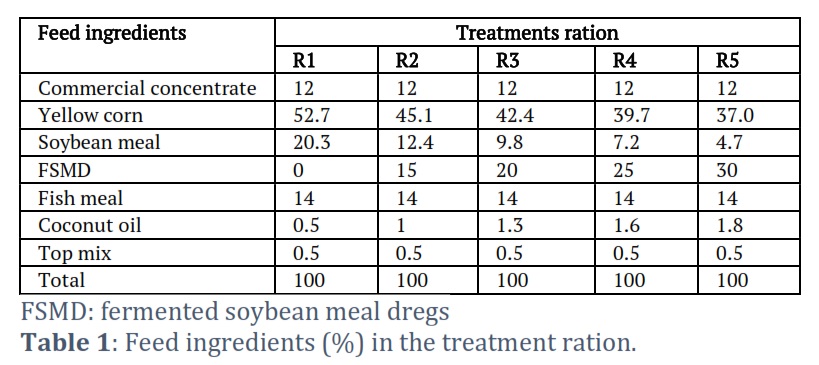
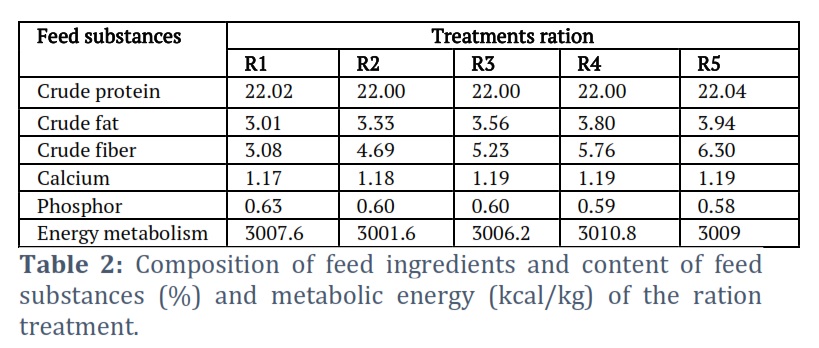
Feeding treatment: The ration comprised yellow corn, soybean meal, fermented soybean milk dregs (FSMD), fish meal, coconut oil, and top mix. The treatment ration was prepared with a balance of 20% crude protein and metabolic energy of 2800 kcal/kg, according to NRC [8]. Subsequently, each material was weighed according to the composition of the treatment ration, stirred, and blended. The composition of feed ingredients, the content of food substances (%), and the metabolizable energy (kcal/kg) of the treatment ration are in Tables 1 and 2. The procedure for making FSMD was carried out by adding SMD and rice bran in an 80:20 ratio as a substrate, with A. ficuum inoculum added at of 10% relative to the substrate. A mixture of substrate and inoculum was incubated in an incubator for nine days. Subsequently, FSMD was harvested, dried in an oven at 50°C, and was given in quail rations.
Data analysis: Data measured were quail feed consumption and conversion, egg production, weight, mass, shell thickness, and yolk color. Subsequently, the data obtained were processed statistically by analysis of variance [9]. Correlation analysis was conducted for each parameter observed using Minitab® version 20.3.
Results
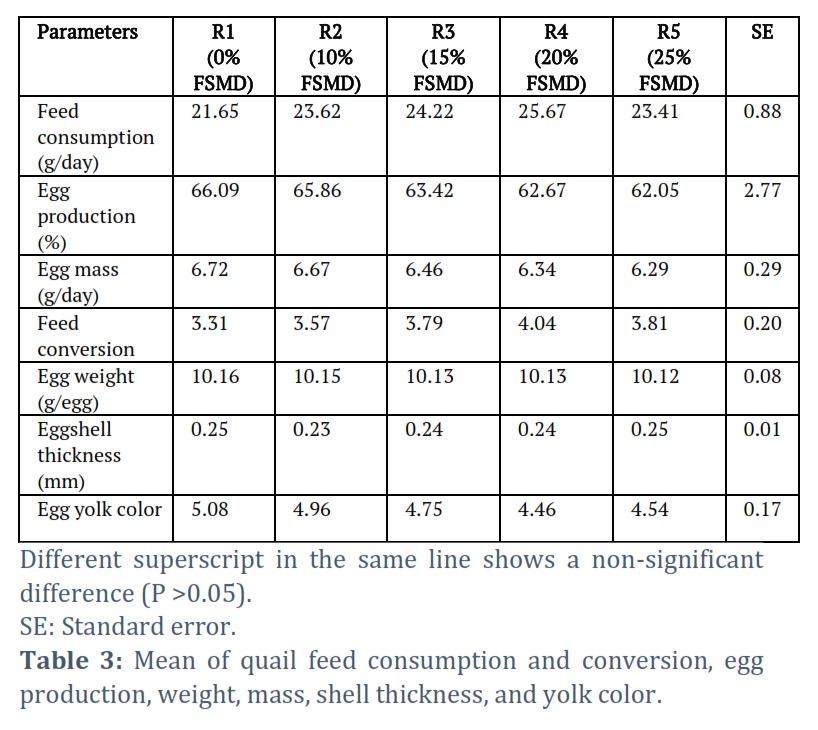
Quail feed consumption: The statistical analysis showed that incorporating 25% FSMD in the diet did not significantly affect (P >0.05) quail consumption. During this study, the average diet consumption ranged from 23.41 g/head/day.
Egg production: The use of 25% FSMD in quail rations showed no significant (P >0.05) effect on egg production, with an average of 62.05-66.09%.
Egg mass: Referring to the statistical analysis, 25% FSMD in the feed did not significantly affect (P >0.05) egg mass. During this study, the average egg mass of quail ranged from 6.29-6.72 g/head/day.
Feed conversion: The statistical analysis indicated that 25% FSMD in the diet did not significantly affect (P >0.05) ration conversion, with an average ranging from 3.60 to 3.82.
Egg weight: Based on statistical analysis, 25% FSMD in the diet did not significantly affect (P >0.05) quail egg weight, with an average of 10.12-10.16 g/egg.
Eggshell thickness: The findings show that the effect of incorporating 25% FSMD in the diet did not significantly affect (P >0.05) eggshell thickness. Based on the results, the average quail eggshell thickness ranged from 0.23-0.25 mm.
Egg yolk color: The incorporation of 25% FSMD in the ration did not significantly affect (P >0.05) the color of quail egg yolks. Furthermore, no significantly different egg yolk color from treatments R1 to R5 showed that the use of 25% FSMD in the rations still gave the same color between treatments, with an average value of 4.54.
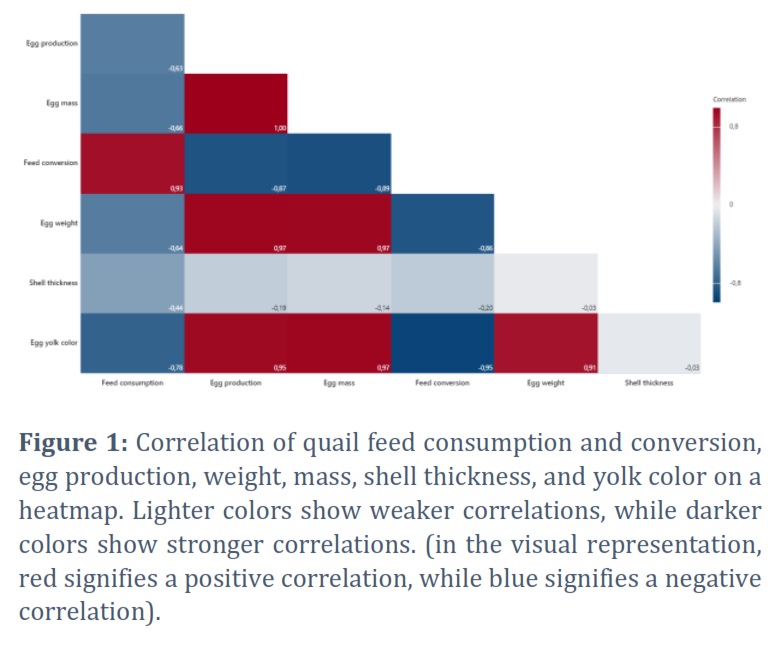
Correlation between parameters: The results of the correlation analysis shown in Figure 1 indicated a strong positive relationship between feed consumption and feed conversion (0.93). This similar trend was also observed in egg production with egg yolk color, weight, and mass, with values of (0.95), (0.97), and (1.00), respectively. A strong positive relationship was observed between egg yolk color with egg mass (0.97), egg mass with egg weight (0.97), and egg yolk color with egg weight (0.91). Meanwhile, a strong negative correlation was found between the parameter pairs egg production and feed conversion (-0.87), egg mass and feed conversion (-0.89), egg yolk color and feed conversion (-0.95), egg weight and feed conversion (-0.86). The parameter of eggshell thickness showed a near-neutral correlation to all observed parameters.
Figures & Tables
FSMD used in quail rations experience significant physical differences during the fermentation, affecting taste, smell, texture, digestibility, and palatability compared to the original ingredients. Similarly, Mirnawati et al., [2] stated that fermentation could improve taste and aroma, palatability, digestibility, and affect consumption. Bahera et al., [10] added fermentation increased the digestibility of nutrients such as amino acids, crude fiber, nitrogen, and palatability of the ration. According to Sukaryana et al., [11], fermented products can change feed ingredients to enhance digestibility, aroma, taste, and eliminate toxins from their original ingredients. The results obtained were higher than Ciptaan et al., [12] who reported an average feed consumption of quail 22.14 g/head/day by using palm oil sludge fermented with Phanerochaete chrysosporium and Neurospora crassa in quail ration.
Fermentation has the potential to improve digestibility, facilitating the use of nutrients for egg production. As explained by Mirnawati et al., [2], fermentation breaks complex bonds of carbohydrates, fats, proteins, crude fiber, or other organic substances to increase their digestibility. In this study, the amino acid content also influenced egg production, as fermented products increased the content of amino acids, which were essential for egg formation. Based on previous studies, Fajrona et al [14] reported a lower value, with an egg production of 57.48%, while Ciptaan et al., [4] showed a 70.93% quail egg production rate.
In this study, the difference between control and treatment was not significant in the egg mass. This was because the number and weight of the eggs were the same, resulting in a similar egg mass due to the relationship between the two parameters. According to Nasikin et al., [15], egg weight is related to egg mass, where the pattern of increasing egg mass is in line with the growth of mature follicles. Kartasudjana and Suprijatna [16] added that egg mass depended on the percentage of daily egg production and weight. The results were higher than Latif et al., [17], with an egg mass of 4.9 g/head/day using fermented shrimp waste flour rations. However, these values were lower compared to those found by Ciptaan et al., [4], with an egg mass of 7.54 g/head/day.
In this study, feed conversion was not different, as both ration consumption and egg mass had no significant effect. This occurred because ration conversion was obtained by comparing consumption and egg mass. Maknun et al., [13] reported the effect of both ration consumption and egg mass in determining conversion rate by comparing the amount of ration spent on egg production and mass [4]. The conversion rate is related to consumption and the ability to transform rations into products such as meat and eggs. This shows that a lower ration conversion rate indicates a more efficient use of ration consumed [18]. However, the results of this study were lower compared to Ciptaan et al., [4], who reported a feed conversion of 3.08. The ratio containing 25% FSMD had the same quality as the control ratio (0% FSMD). This phenomenon resulted in the production of comparable egg weight as the control, according to the insignificant effect in each treatment. Furthermore, the use of FSMD products with A. ficuum improved nutritional quality and increased feed digestibility. According to Mirnawati et al., [2], substances that are fermented have the potential to produce higher quality. Ciptaan et al., [3] added that the fermentation of soybean by-products using A. ficuum increased nitrogen retention by 61.16% and crude fiber digestibility by 58.76%.
The insignificant effect on quail egg weight in each treatment was also caused by the ration energy. This study used iso-energy as the ration to produce eggs with almost the same weight. According to Ciptaan et al., [4], egg weight was not significantly affected by the preparation of rations with comparatively equal protein contents. The absence of significant difference in eggshell thickness indicated that the ration containing 25% FSMD had the same quality as the control ration (0% FSMD), resulting in relatively the same thickness. This occurred due to the same content of Ca and P in the rations of each treatment. The mineral content of calcium and phosphorus affects the quality of the eggshells, as carbonate ions and calcium ions are required to form eggshell CaCO3. According to Jumadin et al., [19], another component that influences eggshell quality is mineral calcium. Shen and Chen [20], also stated that calcium played a role in the efficiency of feed use, egg production, and shell quality, which mainly consists of calcium. The results of this study were higher than Alamsyah et al., [21], who obtained a mean quail eggshell thickness of 0.20-0.21 mm.
This significant increase in digestibility enhanced feed consumption, ensuring nutrient intake for egg formation and increasing weight. In this study, β-carotene was solely obtained from corn for the formation of yolk color. As stated by Kang et al., [22] yolk color was influenced by carotene pigment. Furthermore, Yuwanta [23] added that egg pigments are carotene and riboflavin classified as lipochromes, namely xanthophyll which causes the egg yolk color to become reddish-orange. The results were lower than Zuhri et al., [24], ranging from 5.45-6.35. Although the color of the yolk affected egg quality, Ciptaan et al., [12] obtained an optimum color index of 6.75. FSMD inoculated with A. ficuum can be incorporated into laying quail rations at a level of 25%. The result showed a consistent ration consumption of 23.41 g/head/day, daily egg production 62.05%, egg mass 6.29 g/head/day, conversion ratio 3.81, egg weight 10.12 g/item, shell thickness 0.25 mm, and yolk color 4.54.
Acknowledgment
This study received financial support from Andalas University, with grant number 19/UN.16.17/PP.PGB/LPPM/2018. The authors are grateful to everyone who contributed to the success of this study.
Conflict of Interest
The authors declare that there is no conflict of interest.
GC and M have roles in the study design, supervising the research, and writing the manuscript. QA and AS carried out the research and analysis of the chemical components. MM prepared the graphs and finalized the manuscript.
References
- Ciptaan, G, Mirnawati, Djulardi A. Utilization of fermented soy-milk waste with Aspergillus ficuum in broiler. IOP conference series, Earth and Environmental Science, (2021); 709 (2021): 012044.
- Mirnawati, Ciptaan G, Ferawati. Improving the quality and nutrient content of palm kernel cake through fermentation with Bacillus subtilis ration. Livestock Research for Rural Development, (2019); 31 (7): 2019.
- Ciptaan G, Mirnawati, Aini Q, Makmur M. Nutrient content and quality of soybean meal waste fermented by Aspergillus ficuum and Neurospora crassa. Online journal of Animal and Feed Research, (2022); 12(4): 240-245.
- Ciptaan G, Mirnawati, Ferawati, Makmur M. The effect of fermented palm kernel cake layer quail rations on production performance and eggshell thickness. International Journal of Veterinary Science, (2022); 11(3): 400-403.
- Mirnawati, Ciptaan G, Martaguri I, Ferawati, Srifani A. Improving quality and nutrient content of palm kernel meal with Lactobacillus fermentum. International Journal of Veterinary Science, (2023); 12(4): 615-622.
- Tian M and Yuan Q. Optimization of phytase production from potato waste using Aspergillus ficuum. 3Biotech, (2016); 6: 256.
- Aini Q, Harnentis, Fajrona K, Ciptaan G, Mirnawati, Srifani A. Broiler's responses to containing fermented soybean milk waste with a combination of Neurospora crassa and Aspergillus ficuum. International Journal of Veterinary Science, (2023); 12(4): 593-598.
- [NRC] National Research Council. Nutrient Requirements of Poultry: Ninth Revised Edition, 1994. Washington, DC: The National Academies Press. https://doi.org/10.17226/2114.
- Steel RGD and Torrie JH. Statistics Principles and Procedures of a Biometric Approach (Translation: Bambang Sumantri), 1995; PT. Gramedia, Jakarta.
- Sudhanshu SB, Ray RC. Solid state fermentation for production of microbial cellulases: Recent advances and improvement strategies, International Journal of Biological Macromolecules, (2016); 86: 656-669.
- Sukaryana Y, Atmomarsono U, Yunianto VD, Supriyatna E. Bioconversions of palm kernel cake and rice bran mixtures by Trichoderma viridae toward nutritional contents. International Journal of Scence and Engineering, (2010); 1: 27-32.
- Ciptaan G, Mirnawati and Djulardi A. Performance of quails fed palm oil sludge fermented with Phanerochaete chrysosporium and Neurospora crassa. Livestock Research for Rural Development, (2020); 32: 128.
- Maknun L, Kismiati S, Mangisah I.Production performance of quail (Coturnix japonica) with quail egg hatching waste meal treatment . Jurnal Ilmu-Ilmu Peternakan, (2015); 25 (3): 53-58.
- Fajrona K, Aini Q, Mirnawati. The effect of fermented palm kernel cake with Bacillus subtilis in ration on production performance and quail egg quality. Journal of Research in Agriculture and Animal Science, (2020); 7(5): 06-10.
- Nasikin M, Nangoy FJ, Sarayar CLK Kawatu MHM.Effect of ration substitution with tomato flour (Solanum lycopersicum L) on egg weight, yolk weight and egg mass of layer. Zootek Journal, (2015); 35 (2): 225-234.
- Kartasudjana R and Suprijatna.Poultry Management. 2006; Penebar Swadaya, Jakarta.
- Latif S, Suprijatna E, Sunarti D.Production performance of quail fed fermented shrimp waste meal ration. Jurnal Ilmu-Ilmu Peternakan, (20l7); 27(3): 44-55.
- Mawaddah S, Hermana W, Nahrowi.Effect of feeding deffated BSF larvae (Hermetia illucens) flour on the production of laying quail (Coturnix coturnix japonica). Jurnal Ilmu Nutrisi dan Teknologi Pakan, (2018); 16 (3): 47-51.
- Jumadin L, Satyaningtijas AS, Santoso K. Extract of cassava leaves is a good antioxidant for mature quail which are exposed to heat in short time. Jurnal Veteriner, (2016); 18 (1): 135-143.
- Shen TF and Chen WL. The role of magnesium and calcium in eggshell formation in Tsaiya ducks and Leghorn hens. Asian-Aust. Journal Animal Science, (2003); 16(2): 290-296.
- Alamsyah S, Kismiati S, Yunianto VD.The use of quail egg hatchery waste flour in rations on the physical quality of quail eggs (Coturnix coturnix japonica). Jurnal Pengembangan Penyuluhan Pertanian, (2016); 13(24): 124-129.
- Kang DK, Kim SI, Cho CH, Yim YH, Kim HS. Use of lycopine, an antioxidant carotenoid, in laying hens for egg yolk pigmentation. Asian-Australian Journal of Animal Science, (2003);16(12): 1799-1803.
- Yuwanta T.Eggs and Egg Quality. 2010. Gadjah Mada University Press. Yogyakarta.
- Zuhri MA, Sudjarwo E, Hamiyanti AA. Garlic flour (Allium sativum L) as a natural feed additive in feed on the external and internal quality of eggs in quails (Coturnix coturnix japonica). Maduranch, (2017); 2 (1): 23-30.
This work is licensed under a Creative Commons Attribution-Non Commercial 4.0 International License. To read the copy of this license please visit: https://creativecommons.org/licenses/by-nc/4.0