

Full Length Research Article
In-vitro study on antioxidant status of Zinc NPs and crude extract of Ayurvedic herbal formulation
Jaafar Faez Kadhim Alsadooni1*, Sura Razzaq Khudhair2
Adv. life sci., vol. 11, no. 2, pp. 338-345, May 2024
*– Corresponding Author: Jaafar Faez Kadhim (jaafaralsadoon@gmail.com)
Authors' Affiliations
2. Microbiology and Parasitology Branch, College of Veterinary Medicine, University of Al-Qadisiyah, Ministry of High Education – Iraq
[Date Received: 26/06/2023; Date Revised:09/12/2023; Date Available Online: 18/04/2024]
Abstract
Introduction
Methods
Results
Discussion
References
Abstract
Background: To create and evaluate cutting-edge therapeutic composition on biosynthesized nanoparticles exhibiting varied biological activity, nanotechnology is a novel and forward-thinking method. Increased antioxidant activity decreased toxicity to free radicals as well as cancer cells, and other benefits are achieved carefully by regulating the form and nanoparticle dimensions.
Methods: Nanostructures biosynthesized utilizing Liv-Pro-08 AHF showed a strong antioxidant effect. The creation of novel and more efficient antioxidants may benefit from the usage of nanoparticles. It is noteworthy that the resulting nanoparticles exhibit more biological processes than the extract. This research aims to calculate if there are any noticeable differences in the behaviour of leaf extracts and the many nanomaterials obtained from the aqueous-based separation of Liv-Pro-08 Ayurveda herbal-based formulations.
Results: Several in-vitro free radical scavenging experiments were used to determine whether or not Liv-pro-08 nanoparticles possessed any antioxidant properties. Zinc nanoparticles generated from Liv-pro-08 ayurvedic formulation demonstrated dose-dependent suppression of DPPH, as well as concentration-dependent lowering power potential, indicating that the nanomaterials contain free radical scavenging capability to produce the antioxidant effect.
Conclusion: Nanoparticles might be useful for the development of newer and more potent antioxidants. It is worth mentioning that the resultant nanoparticles possess an elevated biological activity in comparison to the extract. The data represented in our study contribute to a novel and unexplored area of nano materials as alternative medicine.
Keywords: Antioxidants; Biosynthesis; Leaf extract; Liv-pro-08; Zinc
Introduction
Nanotechnology is a mindset, even though the scientific community is fascinated with the field of nanoscience, most of the ongoing discussions, definitions, and attention is focused on nanotechnology. As such, it represents a broad term which demonstrates the apotheosis of man's ceaseless urge for knowledge having practical potential. The meaning of the term nanotechnology is any technology operating on the nanoscale which has applications in the real world, that is, to employ single atoms and molecules to form functional structures [1]. Despite their tiny size, typically between 1 and 100 nm, their high surface-to-volume ratio provides numerous fascinating features, leading to their widespread use in fields as diverse as medicine, construction and materials, catalysis, electronics, optics, and biology [2]. Nanostructures, and particularly metal nanoparticles, were the subject of several research due to the wide range of positive properties they display, including antimicrobial, antifungal, as well as ultraviolet (UV) resistance. Although silver and gold were used for centuries, recent findings indicate that zinc, copper, and aluminium may achieve the same goals [3].
Because of their unique properties, chemical as well as physical synthesizing methods for NMs have certain limits that can be circumvented by biosynthesis. Synthesizing inorganic NPs at ambient temperature and pressure employing naturally occurring microorganisms like bacteria, actinomycetes, and fungi, as well as certain plants and algae, is known as biosynthesis. In current history, researchers have paid a lot of attention to the biosynthesis of NMs, which are produced by organisms such as bacteria, fungal, yeast strains, algal, seeds, as well as plants [4]. With many other creatures, are proposed as promising applications for such a purpose [5]. Because green NP manufacturing using phytoconstituents is particularly cost-effective as well as efficient for large-scale manufacturing. Other benefits, such as greater stability, greater shape and size diversity, and a higher synthesis rate, contribute to their rising popularity. These qualities suggest that aqueous extracts from plants may be a viable replacement for physiochemical approaches [6].
Herbs have become an integral part of local culture with global relevance; the Earth is blessed with a variety of medicinal herbs. These publications have contributed to some development in traditional medicines [7]. Various herbal based/herbal minerals compositions are used for the treatment of inflammation in the Ayurvedic medical system, with positive results [8]. Ayurvedic treatments may involve a solitary spice or a combination of spices (polyherbal). Polyherbal treatment was first introduced in the Ayurvedic text Sarangdhar Samhita' to achieve greater clinical efficacy. Plants don't have enough of the bioactive chemical components needed to provide desirable therapeutic effects. A more potent therapeutic effect and reduced harmful potential can be achieved by using the various spices in the right quantity.
Multiple inflammatory disorders, neurological disorders, and metabolic disorders all include oxidative stress as a central contributor to their pathophysiology. Natural dietary antioxidants inhibit NAFLD, Alzheimer's disease, rheumatism, obesity, as well as metabolic disorders by repressing inflammatory responses, which are triggered by free radicals from a broad range of environmental as well as biological sources [9]. Epidemiological research has compensated for the fact that consuming natural antioxidants will reduce the incidence of such diseases. Since free radicals were also known to show a crucial part in the beginning and progress in inflammation reaction [10]. an additional exertion was used for evaluating its antioxidant potential through in-vitro models including the adventuring of DPPH radicals, hydroxyl oxidative stress, and minimizing possibilities. Antioxidant therapy had gained more popularity in recent years as evidence of oxidative stress's significance in NAFLD development has accumulated. NASH can be helped by making lifestyle changes and getting treatment for risk factors, but these aren't easy to implement or keep up with, leading to dismal compliance statistics over the long run. Because of the widespread nature of this disorder and its effects in the Western world, medication deserves greater attention.
To put it simply, an antioxidant seems to be a chemical that can inhibit or stop other molecules from being oxidized. Although synthetic antioxidants reduce oxidative stress, their use has been limited because of its carcinogenic and damage to the lungs/liver [11]. Researchers are looking at antioxidant compounds, particularly phytochemicals found in plants. The human body is regularly producing reactive oxygen species (ROS) through normal various metabolic processes, such as impart oxidative adverse effects by responding with nearly all the molecules of cells. It has been shown that the body’s natural antioxidant defences are unable to remove excess reactive oxygen species (ROS) and free radicals [12]. The antioxidant molecules found in food serve a vital function as a health buffer. The antioxidant properties of foods plants-derived, like vitamins C and E, carotenoids, phenolic acids, phytic acid, and phytoestrogens, have been acknowledged for their ability to lower the risk of developing various diseases. Most dietary antioxidants are plant-based and are classified into biological and chemical subclasses. While certain chemicals, like gallates, have potent antioxidant properties, others, like monophenols, are relatively powerless in this regard. A key feature of antioxidants is their capacity to mop up harmful free radicals [13].
Because the hepatoprotective efficacy of iv-Pro-08 NPs extract hasn't been studied in depth. The study's principal objective was to determine the presence of enzymatic as well as non-enzymatic defenders in a particular plant source to find the optimum antioxidant strength of the NPs and aqueous extracts of the Ayurvedic herbal preparation Liv-Pro-08. Antioxidant capacity, as well as invitro radical scavenging performances of ethanolic extract and Zinc nanoparticles produced from aqueous leaf extract of Liv-Pro-08 ayurvedic active ingredients, were examined in this study.
Methods
Data Collection
To fulfil the objective, various experimental protocols were deduced for, this study by the following standard procedures.
Selection of Plant Species
The Fruits of Ficus glomerata and seeds of Nigella sativa, Entada pursaetha were collected from Kolli Hills in Namakkal District, Tamilnadu, India.
Preparation of leaves extracts
Fruits are rinsed in both regular and distilled water before being dried in the shade. Each type of dried fruit as well as the seed was processed into a speck of fine dust on its dedicated mechanical grinder. Ethanol to water (or ethanol to ethanol) extraction was performed by using a Soxhlet device, with the powder mixture manufactured in a specified ratio. The extraction pattern continued there until the solvent during an extractor's siphon tube becomes colorless. The extracts are filtrated through Whatman No.1 filter paper, and the solutions were flushed away in a water bath, resulting gave birth to a single mass of the extraction.
Preparation of Aqueous Extract of Liv-Pro-08 Ayurvedic herbal formulation
Freshly harvested Liv-Pro-08 AHF fruits as well as seeds (25 g) are rinsed in running water and then in ultra-pure water to remove any remaining dirt. To a dry 250 mL Erlenmeyer flask, we gradually added mL of triple-distilled water and boiled the mixture at 80 °C for 5 minutes. To prepare the filtrate to be utilized in the green synthesis of NPs, the concentrate was separated using Whatman'sNo.1 filter paper.
Synthesis of Zn nanoparticles by Liv-Pro-08 Extract
Using a stirrer heater, 50 mL of Liv-Pro-08 extracts were heated to 60-80 degrees Celsius enabling Zn nanoparticle formation. Once the temperature exceeds 60 degrees Celsius, 5 grams of zinc oxide were incorporated into the mixture. After being boiled down to a pale-yellow paste, the mix is placed inside a ceramic crucible being cooked in air-heated furnaces at 400 degrees Celsius for 2 hours. The powder, which had a pale-yellow hue, was cautiously gathered and kept for later analysis [12,13]. For more precise characterization, the sample was pulverized using a hammer and pestle.
Enzymatic antioxidant status
An investigation was conducted to analyse the functions of SOD, CAT, GPx, and GST. The plants are vulnerable to harm caused by reactive oxygen species and have thus evolved many antioxidant defence systems, leading to the production of numerous powerful antioxidants. Plants synthesise a wide range of secondary metabolites that possess antioxidant properties. Antioxidants inhibit the activity of free radicals, which have been linked to the development of numerous diseases and the ageing process. Free radicals serve a crucial function in regulating essential biological processes in the body. They play a crucial function in mediating the cell-signalling mechanism that takes place in our body. This demonstrates that free radicals are essential yet simultaneously detrimental to the body. Therefore, it possesses many methods to mitigate the harm caused by free radicals. The damage was restored by the assistance of many enzymes such as superoxide dismutase, catalase, glutathione, peroxidase, and glutathione reductase [14]. Furthermore, antioxidants are crucial components of these defensive mechanisms, typically encompassing vitamin A, vitamin C, vitamin E, and polyphenols. The production of reactive oxygen species (ROS) in biological systems and the resulting oxidative damage are balanced by a variety of enzymatic defence mechanisms. The amounts of antioxidant enzymes were evaluated. Superoxide dismutase (SOD) is a highly efficient catalyst that scavenges the superoxide anion radical (O•− 2), leading to the generation of hydrogen peroxide (H2O2) and oxygen (O2) through the process of dismutation. Liv-Pro-08 exhibits higher levels of GPx activity compared to other NPS, as well as subsequent activity observed for catalase and Glutathione-S-transferase (GST). Catalase exhibits one of the highest reaction rates among all enzymes. Specifically, a single molecule of catalase is capable of converting around 6 million molecules of H2O2 into H2O and O2 each minute. Superoxide dismutase (SOD), classified as EC 1.15.1.1, is an extremely powerful intracellular enzyme that facilitates the transformation of superoxide anions into dioxygen and hydrogen peroxide. The results align with the hypothesis that SOD counteracts the entry of SO ions into the active site of transition metal ions throughout consecutive oxidative and reductive cycles. The primary function of Vitamin E is to protect against lipid peroxidation. Additionally, there is evidence indicating that Vitamin A and C collaborate in a cyclic manner [15]. During the process, α-tocopherol undergoes a transformation into an α-tocopherol radical by giving up a hydrogen atom to a lipid or lipid peroxyl radical. The α-tocopherol radical can then be restored back to its original α-tocopherol form by ascorbic acid. Vitamin C and Vitamin E work together to regenerate α-tocopherol from α-tocopherol radicals in cell membranes and lipoproteins. Additionally, they increase glutathione levels in cells, which plays a crucial role in protecting protein-thiol groups from oxidation. Vitamin C acts as a reducing agent to neutralise reactive oxygen species (ROS) like hydrogen peroxide.
Non-enzymatic antioxidant
This test measures the non-enzymatic antioxidant levels of ethanolic and Nps of Liv-Pro-08, which indicates the amounts of vitamin-C, vitamin-E, and reduced glutathione within certain ranges. Vitamin E functions as a chain-breaking antioxidant in free radical reactions. It plays a crucial role in lipid peroxidation and membrane stabilization. Additionally, it acts as a regulator for the activity of TGF-β1, PPARs, and genes that control collagen deposition, inflammation, and apoptosis [16]. The content of GSH in plants is higher in chloroplasts, measuring at 4 mM, and a substantial amount also accumulates in the cytoplasm. The role of glutathione in plants is well-documented as a radical scavenger, membrane stabilizer, and precursor of heavy metal binding peptides. The current work reveals that ZnNPs exhibit elevated amounts of glutathione and glutathione peroxidase activity. This finding is significant, especially considering that GPx is not commonly seen in numerous plant species. Ascorbate has been detected in several cellular compartments of plant cells, including the chloroplast, cytosol, vacuole, and extracellular compartments. It has been demonstrated to act as a reducing agent for numerous free radicals. Vitamin E demonstrated superior antioxidant activity compared to reduced glutathione and Vitamin C in a non-enzymatic manner. AA serves as a crucial substrate for the reduction of H2O2 in photosynthetic organisms, aiding in its detoxification. A is involved in the catalysis of H2O2 as a substrate of APX. Vitamin C is regarded as a significant indicator of nutritional quality in food processing due to its susceptibility to degradation under thermal treatments. Comparable vitamin deterioration caused by irreversible oxidative processes. The production of reactive oxygen species (ROS) triggers the activation of both enzymatic and non-enzymatic antioxidant systems, which effectively mitigate oxidative stress in the tissues.
Free radical scavenging activity
The current investigation demonstrated that nanoparticles derived from the Liv-pro-08 ayurvedic formulation exhibited dose-dependent inhibition of DPPH. Additionally, the nanoparticles displayed concentration-dependent reducing power potential, indicating their ability to scavenge free radicals and contribute to antioxidant activity. The ayurvedic polyherbal formulation exhibits in vitro antioxidant and anti-inflammatory properties by enhancing reducing power, DPPH, hydroxyl, and radical-scavenging activity [10,17]. This supports the antioxidant effect of Liv-pro-08 nanoparticles.
Superoxide Scavenging Activity
ZnNPs and crude extract of Liv-Pro-08 are determined by the PMS-NBT reduction system. Superoxide (O2) radicals simply react with DNA and super molecules in living systems, necessitating their quick clearance. The superoxide radical ending activity of ZnNPs was shown to be parabolic with increasing doses, with an average inhibition of around 97 percent. During this experiment, ascorbic acid was employed as customary.
Reducing Power
The reducing capacity of ZnNPs was determined by measure its ability to transform Fe3+ to Fe2+. It depends on the dose response curve for the reducing activity of ZnNPs and crude extract of Liv-Pro-08 AHF and antioxidant (ascorbic acid). The inhibition concentration of ZnNPs was found to be 0.18% µg/ml, whereas 0.10% µg/ml crude extract of Liv-Pro-08 AHF and ascorbic acid respectively.
Chelating Ability
The Zn NPs were synthesized utilizing eucalyptus globulus extract by a green technique. The antioxidant and anticancer properties of these NPs were assessed on human colon (HCT-116) and human lung (A-549) carcinoma cell lines. Zinc nanoparticles were utilized as the precursor. The radical scavenging activity or suppression of reactive oxygen species (ROS) was shown to rise as the concentration of Liv-Pro-08 stabilized zinc nanoparticles (ZnNPs) increased [17]. The optimized Liv-Pro-08 stabilized ZnNPs exhibited around 76% potential to suppress scavenging. The higher antioxidant activity is attributed to the efficient transfer of electron density from the oxygen atom to the nitrogen atom (found in DPPH), which is responsible for the presence of unpaired electrons.
Results
XRD, TEM, E-DX Spectrum, and TGA analysis
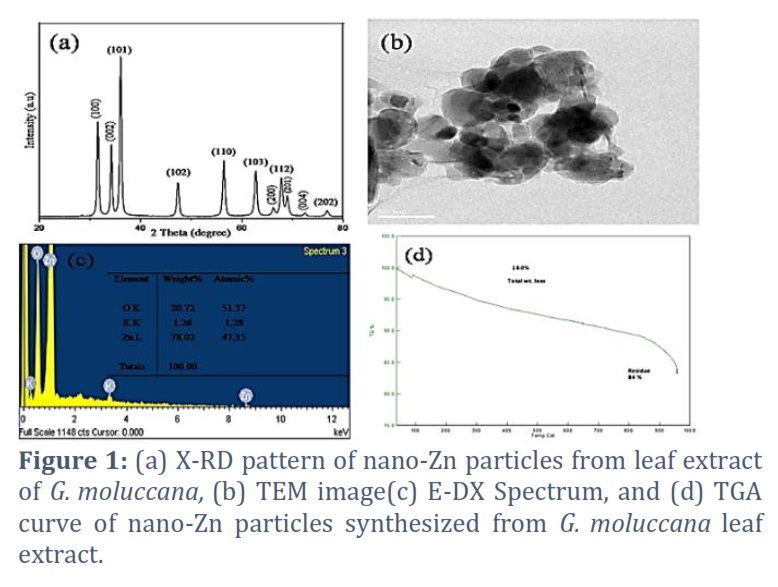
X-ray diffraction (diffractogram) findings for Zn particles show peaks at (100), (002), (101), (102), (110), (103), (200), (112), (004), and (202) degrees. These peaks are located at (31.50), (34.18), (36.05), (47.35), (56.34), (62.65), (66.19), (67.76), (68.92), (72. As illustrated in Fig. 1 (b), diffraction data indicates that the hexagonal patterns in quartzite are indexed to the Zn structure (a). Fig. 1 (b) depicts a TEM picture of nano-Zn particles, showing their hexagonal (quartzite) structure and extremely small sizes (less than 50 nm). The research also demonstrates that mixtures are produced, most likely as a consequence of the particles' increased surface area throughout manufacturing, which were used as the medium and resulted in higher density because mixing particles had a limited amount of space. The primary goal of the technique is to quantify the variation in nanoparticle sizes. Energy dispersive x-ray spectra of the aqueous extract of the aforementioned leaf are shown in Fig. 1. (c). The particles are confirmed here by the presence of zinc and oxygen peaks. Whereas if peaks don't include any unexplained or convey any signals, we can assume that the particles produced by environmental or biological processes are pure. The TGA curve of Fig. 1(d) for the produced Zn particles (d). The loss of mass below 100 degrees Celsius was due to the evaporation of water, and the loss of mass beyond 800 degrees Celsius was due to the breakdown of zinc and oxygen. The size of the resultant particles. Fig. 1(c) depicts the size distribution peaking at 28 nm and varying from 18 to 38 nm, all of which are the result of dynamic light scattering (DLS). The DLS analysis of the produced nano-Zn particles reveals a shape and size distribution with excellent symmetry dispersion diagrams. Green nano-Zn was found to have an average size of 26 nm.
Enzymatic antioxidant status of Zinc NPs and extract of Liv-pro-08 AHF
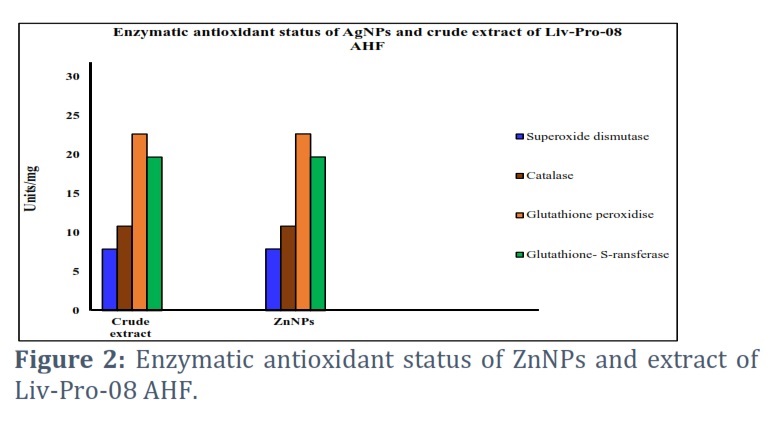
The in vitro antioxidant status of NPs and crude extract of Liv-pro-08 AHF is presented in Fig: 2. The performances of SOD, CAT, GPx, and GST were examined. Its active oxygen can cause harm to plants, so the plants have found widespread antioxidant defence systems, which have led to the production of numerous powerful antioxidants. Among the four enzymatic antioxidants, the activity of catalase in Glutathione peroxidase is highest observed in ZnNPs. However, the activity in other enzymatic antioxidants ranges from (22.70±0.90, 22.71±0.90, 22.63±0.90 and 23.27±0.93 units/mg protein [18]. and peroxidase are two examples of antioxidant enzymes that were demonstrated to boost activity in plants under stress. To create a hydroperoxide, including hydrogen peroxide or lipid hydroperoxide, glutathione peroxidase (GPx) involves the reversibility of glutathione [19].
Glutathione peroxidase activity in ZnNPs is measured at 22.710.90 units/mg protein. It's common knowledge that GPx, a selenium enzyme, controls the levels of hydrogen peroxide and other organic peroxides [20]. Glutathione S transferase ZnNPs antioxidant capacity was found to be highest in leaves. By removing lipid peroxide as well as H2O2, GST and GPx protect subcellular and cellular membranes against oxidative stress. Current research determined the GST concentrations in ZnNPs as well as the crude extract of Liv-Pro-08 AHF, to be (19.74±0.78, 19.75±0.79, 19.65±0.78, 20.78±0.83 units/mg protein) significant. This study reveals that ZnNPs and crude methanolic leaves extract of Liv-Pro-08 AHF promotes protection against LPO. Both catalase and glutathione peroxidase performances are reasonably suggesting their scavenging role in peroxide removal.
Non-enzymatic antioxidant status of NPs and extract of Liv-Pro-08 AHF
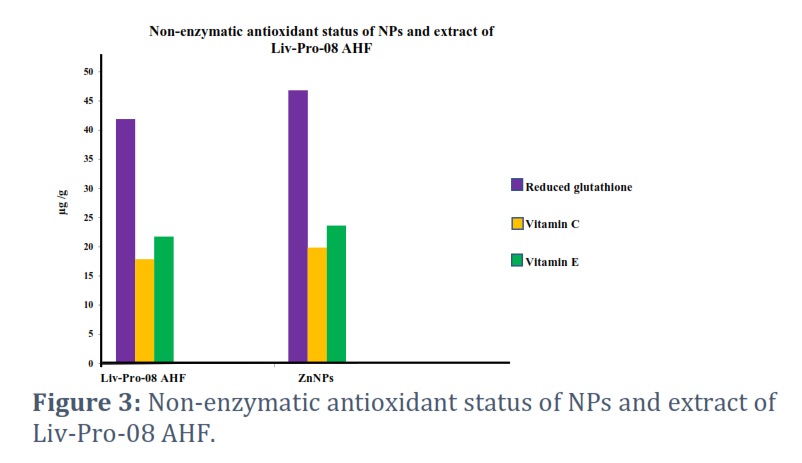
The concentration of several non-enzymatic antioxidants within berries has also been evaluated and the findings are depicted in Fig: 3. Reduced glutathione was found to be within ranges from (46.89±1.87 and46.83±1.87 µg/g) for ZnNPs. GSH levels in the crude extract of Liv-Pro-08 AHF decreased than that of ZnNPs. The cytosol & chloroplasts both develop a substantial amount of GSH within plants, but the chloroplast concentration is larger (about 4 mM) [20]. Glutathione has been studied extensively for its antioxidant, membrane-stabilizing, as well as heavy-metal-binding roles in plants [21]. Given that GPx has not been reported throughout many tree species, the finding that ZnNPs have significant quantities of glutathione, as well as glutathione peroxidase performances, is noteworthy. Evidence suggests that Vitamins A and C interact within a continuous cycle, with Vitamin E’s primary function being to protect against lipid peroxidation. By giving up a variable amount of hydrogen to the lipid as well as lipid peroxyl radical, -tocopherol is converted into the reactive -tocopherol radical, that ascorbic acid, may restore to its natural form [22]. Vitamin C boosts glutathione levels within membranes as well as lipoproteins, whereas vitamin E aids in the regeneration of -tocopherol from -tocopherol radicals in these cellular compartments, which plays a crucial function in protecting protein thiol groups from oxidation. Vitamin C behaves as a reducing mediator, rendering reactive oxygen species (ROS) like hydrogen peroxide inert [20,22]. As a regulator of TGF-1, PPARs, and genes governing cellular proliferation, inflammatory, and apoptosis.
Vitamin C and Vitamin E content in ZnNPs with a concentration range from 46.83±1.87 and 23.63±0.94 mg/g. Ascorbate acts as a reducing agent for several free radicals and was detected within chloroplast, cytoplasm, vacuole, as well as extracellular regions of cell membranes. In non-enzymatic antioxidants, Vitamin E had effective activity when compared to the reduced glutathione and Vitamin C. AA is a crucial reducing substrate for H2O2 removal of harmful substances in plant-based photosynthesis [19]. A participates in the removal of H2O2 as a substrate of APX. Although it degrades quickly in high temperatures, vitamin C is nonetheless used as an indicator of food quality throughout processing. Several authors have documented a similar loss of vitamins as a result of irreversible oxidative processes. When reactive oxygen species (ROS) are generated, tissues can recover from oxidative stress by activating enzymatic as well as non-enzymatic antioxidant mechanisms.
Free radical scavenging activity of CCNPs and methanolic leaves extract of Canthium coromandelicum Diphenyl-picrylhydrazyl radical (DPPH·) scavenging activity
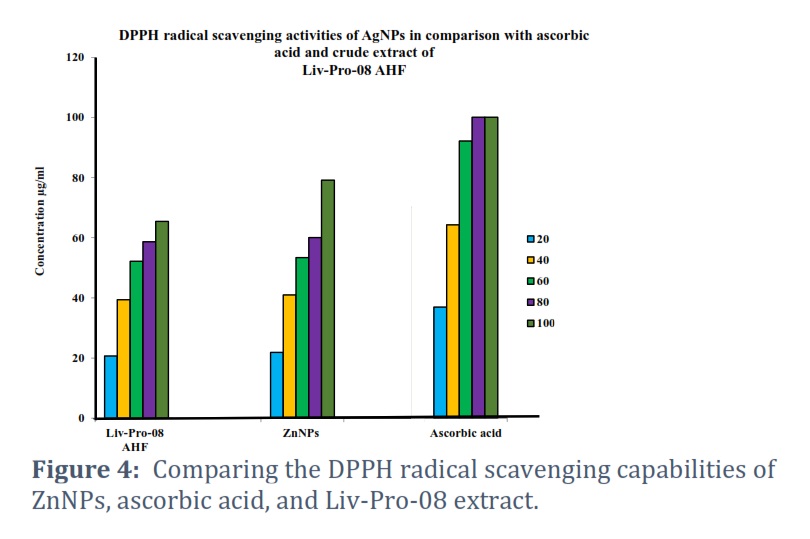
The antioxidant potential of the aqueous leaf extract containing ZnNPs with crude extract of Liv-Pro-08 was evaluated in a variety of in vitro models at doses varying from 20 to 100 g/ml. Across all models, it must have been found that the concentration at which free radicals are scavenged mostly by test chemicals increased with increasing concentration. The rate of waste disposal by scavengers. The outcomes of the DPPH assay demonstrate unequivocally of crude extracts are effective free radical scavengers. According to the DPPH scavenging experiment, ZnNPs and the aqueous extracts of Liv-Pro-08 AHF displayed potent inhibitory activity, outperforming the quality, of ascorbic acid (Fig: 4). A dose-dependent elevation in the nanoparticles' DPPH activity was detected. Several in-vitro free radical scavenging experiments were used to determine whether or not Liv-pro-08 nanoparticles possessed any antioxidant properties. Various nanoparticles synthesized out from Liv-pro-08 ayurvedic composition decided to show the dose-dependent inhibitory activity of DPPH (Fig. 4), as well as reducing power potential that varied with concentration, indicating also that Liv-pro-08 nanostructures have scavenging of free radicals possibility that contributes to their antioxidant properties. To back up the antioxidant effect of Liv-pro-08 nanoparticles, [4,5,19]. found that Trayodashang Guggulu, an ayurvedic polyherbal composition, had anti-aging and anti-inflammatory properties as measured by lowering power, DPPH, hydroxyl, radical-scavenging ability, and more.
Figures & Tables
Plants are vulnerable to harm caused by reactive oxygen species and have thus evolved many antioxidant defence systems, leading to the production of numerous powerful antioxidants [1]. Plants synthesise a wide range of secondary metabolites that possess antioxidant properties. Antioxidants inhibit the activity of free radicals, which have been linked to the development of numerous diseases and the ageing process. Free radicals serve a crucial function in regulating essential biological processes in the body. They play a crucial part in mediating the cell-signalling mechanisms that occur in our body. This demonstrates that free radicals are essential yet simultaneously detrimental to the body. Therefore, it employs various ways to mitigate the harm caused by free radicals. The damage was restored by the assistance of many enzymes such as superoxide dismutase, catalase, glutathione, peroxidase, and glutathione reductase. Furthermore, antioxidants are essential components of these defensive mechanisms, often encompassing vitamin A, vitamin C, vitamin E, and polyphenols. The production of reactive oxygen species (ROS) in biological systems and the resulting oxidative damage are balanced by a variety of enzymatic defence mechanisms. The amounts of antioxidant enzymes were evaluated. Superoxide dismutase (SOD) is a highly efficient catalyst that scavenges the superoxide anion radical (O•− 2) and facilitates its dismutation into hydrogen peroxide (H2O2) and oxygen (O2) [3-5].
The human body possesses defence mechanisms to counteract oxidative stress caused by free radicals. These mechanisms include preventive measures, repair processes, physical defence, and antioxidant defence. Enzymatic antioxidant defence mechanisms consist of superoxide dismutase (SOD), glutathione peroxidase (GPx), catalase (CAT), and others. Non-enzymatic antioxidants include ascorbic acid (vitamin C), α-tocopherol (vitamin E), glutathione (GSH), carotenoids, flavonoids, and so on. These actions are achieved through many processes, such as decreasing activity, scavenging free radicals, potentially neutralising pro-oxidant metals, and extinguishing singlet oxygen. ROS receive significant scrutiny due to several elements such as drought, cold, heat, herbicides, and heavy metals, since they detrimentally impact cells by elevating oxidative levels through the degradation of cellular structure and functions [17, 18].
The overall antioxidant efficacy of NPs and crude extract of Liv-Pro-08 was compared to that of the Standards. Due to the intricate composition of phytochemicals, the assessment of antioxidant properties in plant extracts cannot rely solely on a single methodology. Hence, well acknowledged tests were utilised to assess the overall antioxidant properties of NPs and the unrefined Liv-Pro-08 extract. Future in vivo investigations should be encouraged to further investigate the results, perhaps paving the way for the use of these therapeutic plants in pharmaceutical and cosmetic formulations [10-14].
Advanced drug compositions may now be developed and tested using nanotechnology, which allows for the use of biosynthesized nanostructures with a wide range of biological functions. When it comes to enhancing antioxidant properties and lowering free radicals as well as cancer cell toxicity, the form and dimension of nanoparticles were crucial. Biosynthesized nanoparticles made with Liv-Pro-08 AHF showed potent antioxidant properties. Novel and more efficient antioxidants could be created with the help of nanoparticles. Importantly, the resulting nanoparticles have a much higher bioactivity than the extract did. Our findings shed light on hitherto uncharted territory in the field of nanomedicine. Thus, more research is required to completely define the phyto-nanostructures as well as the factors underlying with said antioxidant capacity of these nanoparticles.
Conflict of Interest
The authors declare that there is no conflict of interest.
Jaafar Faez Kadhim Conducted the experiment and authored the manuscript with assistance from Sura Razzaq Khudhair Contributed to the design and fabrication of nanoparticles. Jaafar Faez Kadhim oversaw the effort and made significant contributions to the research's design and implementation, the analysis of the findings, and the preparation of the report. Sura Razzaq Khudair Assisted in overseeing the project. The authors affirm the absence of any known conflicts of interest. The authors engaged in discussions regarding the results and made contributions to, as well as reviewed, the final manuscript.
References
- Nasrollahzadeh M, Sajadi SM, Sajjadi M, Issaabadi Z (2019) An introduction to nanotechnology. Interface science and technology: Elsevier. pp. 1-27.
- Feitosa VA, Pinto TdJA, Dua K, Cerize NNP (2021) Advances in polymeric nanoparticles for drug delivery systems in cancer: Production and characterization. Advanced Drug Delivery Systems in the Management of Cancer: Elsevier. pp. 331-341.
- Akhtar MS, Panwar J, Yun Y-S. Biogenic synthesis of metallic nanoparticles by plant extracts. ACS Sustainable Chemistry & Engineering, (2013); 1(6): 591-602.
- Sharpe E, Farragher-Gnadt AP, Igbanugo M, Huber T, Michelotti JC, et al. Comparison of antioxidant activity and extraction techniques for commercially and laboratory prepared extracts from six mushroom species. Journal of agriculture and food research, (2021); 4100130.
- Sunil K, Suma A, Ashika B, Roy CL, Naresh S, et al. GCMS And FTIR analysis on the methanolic extract of coriandrum sativum leaves. European journal of pharmaceutical and medical research, (2018); 5455-457.
- Hutchison JE. Greener nanoscience: a proactive approach to advancing applications and reducing implications of nanotechnology. ACS nano, (2008); 2(3): 395-402.
- Liu J, Jia L, Kan J, Jin C-h. In vitro and in vivo antioxidant activity of ethanolic extract of white button mushroom (Agaricus bisporus). Food and chemical toxicology, (2013); 51310-316.
- Mondal A, Chowdhury S, Mondal N, Shaikh W, Debnath P, et al. Insecticidal and fungicidal performance of bio-fabricated silver and gold nanoparticles. International Journal of Environmental Science and Technology, (2022); 1-20.
- Angulo P. Nonalcoholic fatty liver disease. New England Journal of Medicine, (2002); 346(16): 1221-1231.
- Austin LA, Mackey MA, Dreaden EC, El-Sayed MA. The optical, photothermal, and facile surface chemical properties of gold and silver nanoparticles in biodiagnostics, therapy, and drug delivery. Archives of toxicology, (2014); 881391-1417.
- Aliyu AB, Ibrahim MA, Musa AM, Musa AO, Kiplimo JJ, et al. Free radical scavenging and total antioxidant capacity of root extracts of Anchomanes difformis Engl.(Araceae). Acta Pol Pharm, (2013); 70(1): 115-121.
- Ansari MA, Khan HM, Alzohairy MA, Jalal M, Ali SG, et al. Green synthesis of Al 2 O 3 nanoparticles and their bactericidal potential against clinical isolates of multi-drug resistant Pseudomonas aeruginosa. World Journal of Microbiology and Biotechnology, (2015); 31153-164.
- He L-H, Yao D-H, Wang L-Y, Zhang L, Bai X-L. Gut microbiome-mediated alteration of immunity, inflammation, and metabolism involved in the regulation of non-alcoholic fatty liver disease. Frontiers in microbiology, (2021); 12761836.
- Arome D, Chinedu E. The importance of toxicity testing. Journal of Pharmaceutical and BioSciences, (2013); 4146-148.
- Song JY, Kim BS. Rapid biological synthesis of silver nanoparticles using plant leaf extracts. Bioprocess and biosystems engineering, (2009); 3279-84.
- Arulselvan P, Fard MT, Tan WS, Gothai S, Fakurazi S, et al. Role of antioxidants and natural products in inflammation. Oxidative medicine and cellular longevity, (2016); 2016.
- El-Maddawy ZK, El-Sawy AE-SF, Ashoura NR, Aboelenin SM, Soliman MM, et al. Use of zinc oxide nanoparticles as anticoccidial agents in broiler chickens along with its impact on growth performance, antioxidant status, and hematobiochemical profile. Life, (2022); 12(1): 74.
- Suma A, Ashika B, Roy CL, Naresh S, Sunil K, et al. GCMS and FTIR analysis on the methanolic extract of red Vitis Vinifera seed. World Journal of Pharmaceutical sciences, (2018); 106-113.
- Singh M, Manikandan S, Kumaraguru A. Nanoparticles: a new technology with wide applications. Research Journal of Nanoscience and Nanotechnology, (2011); 1(1): 1-11.
- Virkutyte J, Varma RS. Green synthesis of metal nanoparticles: biodegradable polymers and enzymes in stabilization and surface functionalization. Chemical Science, (2011); 2(5): 837-846.
- Al-Habori M, Al-Aghbari A, Al-Mamary M, Baker M. Toxicological evaluation of Catha edulis leaves: a long term feeding experiment in animals. Journal of ethnopharmacology, (2002); 83(3): 209-217.
- Arora A, Sairam R, Srivastava G. Oxidative stress and antioxidative system in plants. Current science, (2002); 1227-1238.
This work is licensed under a Creative Commons Attribution-Non Commercial 4.0 International License. To read the copy of this license please visit: https://creativecommons.org/licenses/by-nc/4.0