Full Length Research Article
Evaluation of the produced flavone's protective properties against oxidative stress and dyslipidemia in male rats with iron-induced hepatotoxicity
Farah Dheyaa Ahmed Haddad1, Hind Bahjat Mohammed Aldik2*, Aseel Ibrahim Suhail2
Adv. life sci., vol. 12, no. 3, pp. 522-527, August 2025
*- Corresponding Author: Hind Bahjat Mohammed Aldik (Email: Hind.Bahjat1102a@csw.uobaghdad.edu.iq)
Authors' Affiliations
2. General Directorate of Education, Baghdad, Rusafa – Iraq
[Date Received: 25/12/2024; Date Revised: 30/01/2025; Available Online: 31/10/2025]
Abstract
Introduction
Methods
Results
Discussion
References
Abstract
Background: Hepatotoxicity is liver damage due to exposure to a toxic substance such as medications, alcohol, or certain chemicals. Iron induced hepatotoxicity may occur if the supplement is taken in excess or for an extended period.
Methods: This study aimed to synthesize a series of flavone derivatives and estimate their roles as protective agents against iron-induced hepatotoxicity. Confirmation of the structure of the synthesized chalcone and flavone products was obtained through the use of FTIR spectroscopy as well as other physicochemical properties.
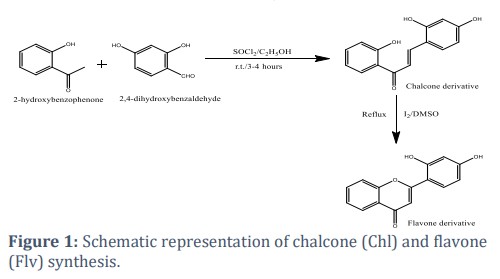
Results: Excellent yields of chalcone derivatives were obtained through Aldol condensation of 2-hydroxyacetophenone and 2,4-dihydroxybenzaldehyde using SOCl2/ETOH as a catalyst. In contrast, oxidative cyclization of the synthesized 2'-chalcone derivative in dimethyl sulfoxide (DMSO) with iodine affords the corresponding flavone derivatives.
Conclusion: The novel flavone compound exhibited a substantially efficient capability in hepatoprotection against iron overload, and we found that it exhibited antioxidant activity.
Keywords: Chalcone derivative, Flavone derivative, Ferrous sulfate, Hepatotoxicity
Introduction
One of the most popular iron supplements prescribed in the prevention and treatment of anemia is ferrous sulfate. Patients who are receiving a low amount of iron from diets alone are most advised to take this form of iron, which is readily absorbed by the gut. Ferrous sulfate comes in several dosage forms, such as pills, capsules, and syrups [1]. Some general adverse effects of ferrous sulfate are gastrointestinal upset, constipation, and pigmenting of stools [2].
Hepatotoxicity is liver damage occasioned by exposure to a toxic or harmful agent such as medication, alcohol, or chemicals. Iron-induced hepatotoxicity could be caused if the supplement is consumed in larger doses than the recommended dose or if it was taken on a long-term basis. Hepatotoxicity symptoms are usually abdominal pain, nausea, vomiting, jaundice, and dark urine [3]. Disruption of lipid homeostasis with the potential ability to increase the cardiovascular disease risk is among the effects of ferrous sulfate toxicity [4]. In the Journal of Trace Elements in Medicine and Biology, in a study, it was observed that ferrous sulfate supplementation in normal males increased LDL cholesterol and decreased HDL cholesterol. Increased LDL cholesterol gives a higher cardiovascular disease risk, but HDL cholesterol eliminates unwanted cholesterol from the body [5]. In another study, it was found that levels of hepatic oxidative stress and inflammation markers were higher in rats fed ferrous sulfate, and increased the cardiovascular disease risk [6]. Oxidative stress in hepatotoxicity and liver disease was mitigated by antioxidant therapy [7].
Chalcones are plant polyphenolic compounds in the flavonoid class. Chalcones, bioprecursors of all flavonoids, are compounds whose benzene ring patterns are identical or dissimilar and are connected by a three-carbon α,β-unsaturated carbonyl linkage [8]. Chalcones have a broad range of biological activities, and among all, antioxidant, anti-inflammatory, and anticancer activities are noteworthy. Chalcones are found in a great variety of plants, including licorice root, turmeric, and ginger, as well as in fruits and vegetables. Chalcone derivatives are synthesized and are used as medicinal compounds and in the biosynthesis of other biologically active derivatives [9].
Flavones are a subclass of flavonoids encountered immensely as natural compounds in the plant kingdom. The flavonoids are efficient in scavenging free radicals and encompass multiple other biological activities as well, namely inhibition of inflammation and antiviral and anticancer activities. The flavones include a characteristic chemical structure in the form of a carbon skeleton as a C6-C3-C6 and a chroman ring containing a secondary aromatic ring in position 2. The study demonstrates that flavones tend to offer a variety of potential positive effects on human health. Some researchers hypothesize that the compounds tend to offer anti-inflammatory and antioxidant actions and could potentially protect against chronic disorders in a period, namely heart disorder, diabetes, and carcinoma [10]. To manufacture ultra-pure flavones, a variety of processes have been utilized as efficient instruments. In addition to pyrone synthesis by Allan-Robinson, Baker-Venkataraman, Kostanecki, and Suzuki-Miyaura reaction processes are utilized on a bulk level in flavone synthesis [11]. The most efficient method among all is using iodine in a medium of DMSO in oxidative cyclizing the synthesized product as a chalcone derivative [12]. The purpose of this work was to synthesize and evaluate the preventive capabilities of a flavone derivative against oxidative stress and dyslipidemia in male rats with iron-induced hepatotoxicity.
Methods
Chemicals and drugs
Ferrous sulfate, 2-hydroxyacetophenone, and 2,4-dihydroxybenzaldehyde were bought from Himedia (India). The quality of all these chemicals obtained from a standard commercial source was AnalaR grade, and they were used without further purification. Thomas Hoover (England) used the open capillary technique to specify the melting points, and the results were uncorrected. When required, reactions were cooled with a Julabo chiller VC (F30) (GmbH, Germany). Elemental microanalysis was performed at the Jordanian University utilizing a CHN Elemental Analyzer (Euro-vector EA3AA, Italy). Infrared spectra were performed on KBr discs at the Faculty of Pharmacy, University of Baghdad, utilizing a Shimadzu FTIR 8400 spectrophotometer (Japan). Using the ascending TLC technique on GF254 (60) aluminum sheets (E. Merck, Germany), the progress of the reaction was tracked, and the purity of the result was determined using a mobile phase consisting of ethyl acetate and petroleum spirit (40:60). Derivatization, reactivity towards iodine vapor, or UV254 light was utilized to reveal the synthesized compound. The biochemical studies of the hepatic enzymes and lipid profiles were conducted at the University of Al-Kufa, Pharmacognosy Department, College of Pharmacy.
Chemical synthesis of the chalcone derivative (Chl)
A mixture of 2-hydroxyacetophenone [0.1 mol/1.36 g] & 2,4-dihydroxybenzaldehyde [0.1 mol/1.38 g] was dissolved in ethanol (20 mL), and SOCl₂ (0.1 mol/0.625 mL) was added drop-by-drop over the course of five minutes while vigorous agitation was maintained for three to four hours at room temperature. The solution immediately turned an intense red. After half an hour of stirring, the solution became coagulated. Following stirring for 3-4 hours, the reaction mixture was left for a couple of hours. After that, 50 mL of cold distilled water were added to the reaction solution to cause precipitation. The precipitate was then obtained by filtration, which was then washed twice respectively with 20 mL of cold distilled water, cold C₂H₅OH, and cold C₂H₅OC₂H₅. The washed precipitate is left to dry to produce the chalcone derivative (see Fig. 1). This derivative was recrystallized from ethanol [12].
(E)-3-(2,4-dihydroxyphenyl)-1-(2-hydroxyphenyl) prop-2-en-1-one (Chl)
Orange solid; m.p. 155–157 °C; yield 88%; IR (Potassium bromide/cm⁻¹): 3224 (–OH), 3032 (C = CH), 1643 (C = O), 1562, 1510 (C = C, aromatic). The analysis calculated with respect to C₁₅H₁₂O₄ gave C = 70.31%; H = 4.72%; O = 24.97%. Found values were C = 70.65%; H = 4.80%; O = 24.55%, which are within the acceptable ±0.4% analytical range, confirming the purity and correct empirical composition of the synthesized compound.
Chemical synthesis of the flavone derivative (Flv):
I₂ (10 mmol) was added to a refluxed solution of 100 mL dimethyl sulfoxide containing 10 mmol of the synthesized chalcone derivative [2.56 g] for one hour. After that, the mixture was transferred to water and extracted using 3×30 mL of ethyl acetate. Using brine, the organic layer has been rinsed until neutral and then dried with anhydrous magnesium sulfate. A rotary evaporator (rotovap) was employed to exhaust solvent under vacuum conditions. The column chromatography column (silica gel, petroleum ether: methylene dichloride (0-30%)) was then used for purification (Figure 1) [13].
2-(2,4-dihydroxyphenyl)-4H-chromen-4-one (Flv)
Yellow solid; m.p. 240-241°C; yield 83%; IR (Potassium bromide/cm⁻¹): 3665 (-OH), 3031 (C=CH), 1656 (C=O), 1590 (C=C, aromatic), 1089 (C-O-C); Anal. Calcd. for C₁₅H₁₀O₄: C = 70.86%; H = 3.96%; O = 25.17%. Found values were C = 70.78%; H = 3.91%; O = 25.31%, which are within the acceptable ±0.4% analytical range, confirming the purity and correct empirical composition of the synthesized flavone derivative.
Experimental animals
Forty adult male albino rats (170–180 g), aged five to six months, were used for this study. All experimental procedures were conducted in accordance with the NIH Guide for the Care and Use of Laboratory Animals and approved by the Institutional Animal Ethics Committee of the University of Kufa (Approval No. UK-PH-AEC-2024/02). During a two-week acclimation period, the animals were housed in hygienic polypropylene cages at 25 ± 2 °C with 40–50% relative humidity and a 12-hour light/dark cycle. They were provided unrestricted access to standard pellet diets and water ad libitum.
Experimental design
Ferrous sulfate (Fe) powder was dissolved in isotonic saline at a concentration of 30 mg/mL, and each rat underwent intraperitoneal injection of 30 mg/kg daily for 14 days. Two weeks into the experiment, each rat was given an intragastric tube with 80 mg/kg of its weight of a synthetic flavone derivative (Flv) powder that had been dissolved in 0.1% carboxymethylcellulose. This was done every day. The animals were split up into four equal groups at random (n=10):
Group I: Used for two weeks as a control (0.9% NaCl solution).
Group II: Treated animals orally with Flv (80 mg/kg) for 2 weeks.
Group III: Fe (30 mg/kg) was given to animals for 2 weeks.
Group IV: Animals were co-administered Flv (80 mg/kg, oral) and Fe (30 mg/kg, intraperitoneal) daily for 2 weeks.
Blood samples were taken from the rats after two weeks of treatment in order to separate the serum, and heparin was not used in this process. Serum obtained through centrifugation was employed for various biochemical analyses.
Serum hepatic enzymes assessment
Commercial diagnostic kits were used from Bio Systems S.A. in Barcelona, Spain, for the purpose of determining serum (AST) and (ALT) activity levels, which was done as per the suggested method by Reitman and Frankel (1957). By using a commercial diagnostic kit (Spectrum, Hannover, Germany) and following the phenyl phosphate method by Principato et al., [12], serum (ALP) activities were measured. The Walters and Gerade method was utilized to assess serum total bilirubin (TB) concentrations utilizing a commercial diagnostic kit (SCICO diagnostics, Egypt).
Assessment of lipid profile
Using commercial diagnostic kits, the serum samples were examined for total cholesterol (TC; cat. no. 11805), triglycerides (TG; cat. no. 11828), and high-density lipoprotein-cholesterol (HDL-c; cat. no. 11557) in accordance with the manufacturer's instructions (Bio Systems S.A., Barcelona, Spain). By dividing the TG readings by a factor of 5, levels of very low-density lipoprotein-cholesterol (vLDL-c) in serum were computed. Levels of low-density lipoprotein-cholesterol (LDL-c) in serum have been calculated using the following equation:
LDL-c (mg/dL) = TC (mg/dL) − HDL-c (mg/dL) − [TG (mg/dL)/5]
Statistical analysis
The data were analyzed utilizing SPSS for Windows (version 17.0). Tukey's multiple comparisons method was employed following a one-way analysis of variance (ANOVA) to assess the significance of differences. Statistical significance was established at p < 0.05.
Results
Effect of the synthesized flavone derivative (Flv) on the serum hepatic enzymes
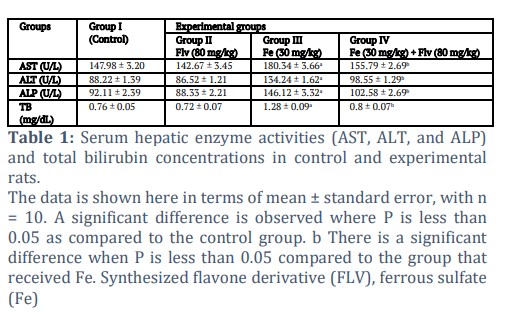
The mean values of the serum (AST), (ALT), and (ALP) activities in addition to total bilirubin (TB) concentrations of male rats treated with Flv, Fe, and their combination for 14 days were shown in Table 1 and Figures (2A-D). The serum AST, ALT, and ALP activities, in addition to serum TB concentrations, were shown to be considerably (p < 0.05) higher in the Fe-treated group compared to that of the control group. However, as compared to the Fe-treated group, the rat group treated with both Fe and Flv demonstrated a considerable (p < 0.05) drop in the activities of these enzymes and TB concentrations.
Effect of the synthesized flavone derivative (Flv) on lipid profile
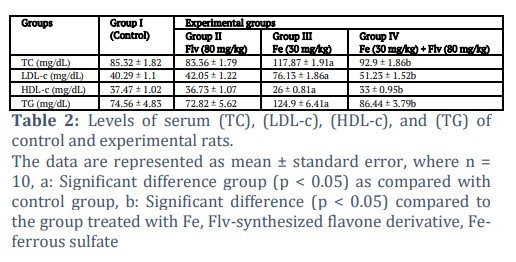
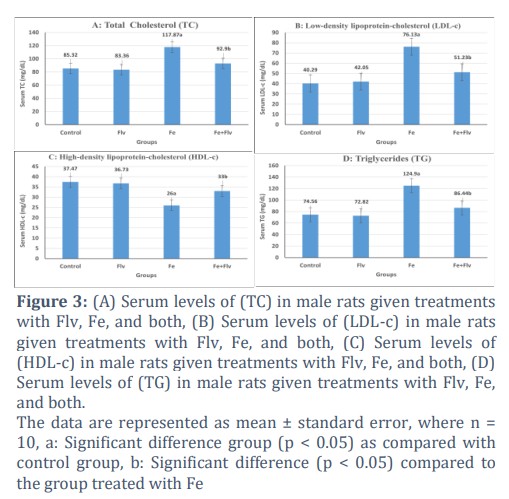
As depicted in Table 2 and Figures 3A-D, iron administration induced a state of dyslipidemia in male rats. The iron-treated group compared with the control group exhibited statistically significant (p < 0.05) increments in serum total cholesterol (TC), LDL-c, and triglycerides (TG). Correspondingly, there was a significant (p < 0.05) decline in HDL-c levels. Conversely, the lipogram in the flavone-only-treated rats was not significantly different (P > 0.05) from the control rats. Significantly, cotreatment with iron and flavone substantially suppressed the lipid defects, and significantly reduced levels of lipids (p < 0.05) were noted compared with the iron-only group.
Figures & Tables
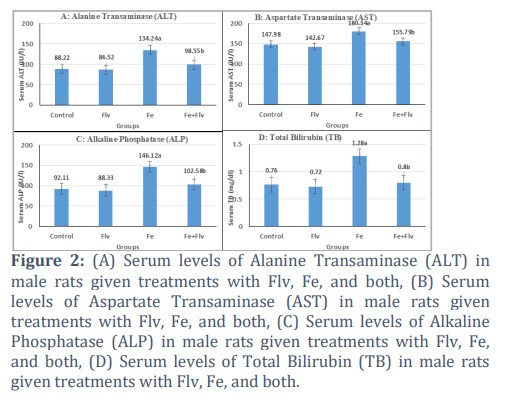
The point of this study was to find out how the synthesized flavone derivative (Flv) could protect animals' livers from damage caused by iron. The current work took into account the injury produced by iron by assaying the release of ALT and AST into the circulation [15,16]. Increased contents of blood ALT and AST were noted in the current work. This shows the damage to hepatocyte mitochondria by iron toxicity, causing oxidative stress. These elevated activities are most likely an indication of compromised liver membrane integrity, with leakage of damaged hepatocyte enzymes into the circulation [17]. Increased activities of serum alkaline phosphatase are a definitive marker of cellular injury resulting from impaired membrane function. Total bilirubin (TB) is a well-established marker of tissue injury by toxic chemicals, and in iron-treated rats, it was significantly elevated. The flavone product prepared in the current work, at 80 mg/kg dose, could potentially stabilize the damaged cellular membrane of injured liver and protect hepatocytes against iron toxicity, thereby decreasing leakage of the enzymes into the circulation. In reference, the citrus flavonoid compound, Hesperidin, with a protective function in the cellular membrane, has been established earlier [18].
The synthesis of a flavone derivative (Flv), which chelates iron, effectively reduced iron accumulation in the blood. In addition, the synthesized flavone’s hydroxyl groups or its primary metabolites may chelate iron and increase its excretion, thereby reducing iron accumulation and iron's toxic effects. It is widely accepted that Flv functions as an antioxidant compound that can remove excess iron from biological systems [19].
A high dose of iron may cause lipid metabolism variations as well as variations in serum and tissue lipid concentrations. The resultant outcome can be ascribed to iron overload within the liver, a condition established to modulate lipid homeostasis. In the work herein, iron administration induced a dyslipidemic profile, characterized as elevated serum total cholesterol (TC), low-density lipoprotein cholesterol (LDL-c), and triglycerides (TG), and reduced high-density lipoprotein-cholesterol (HDL-c), respectively. These alterations were significantly corrected by coadministration of the flavone (Flv). Mechanistically, in excess, iron is established as modulating the expression of liver enzymes' genes. Specifically, it is shown capable of upregulating 3-hydroxy-3-methylglutaryl coenzyme A (HMG-CoA) reductase, the biosynthetic limiting enzyme in cholesterol, producing hypercholesterolemia. This fits in consonance with prior communications on the effect of heavy metals on the expression of HMG-CoA reductase [20]. The protecting effectors role played by the flavone is most likely ascribed to its antioxidant activity, saving membrane lipids from peroxidation triggered by free radicals. In turn, as a corollary, the flavone herein was found to forestall the pathological release into circulation by the membranes’ abnormal contents and forestall synthesis of unwanted peroxides, thereby preventing resultant later cellular and tissue lesions. The ability of phytochemicals to lower elevated cholesterol and triglyceride levels is clinically important since these parameters are most significantly linked with a reduced cardiovascular disease risk [21].
Acknowledgement
The authors are thankful to Assist. Prof. Samer Ali Hasan at the University of Kufa for supporting this work.
Author Contributions
All authors participated in the conceptualization, design of the methodology, data collection, and analysis, as well as the preparation of the initial manuscript draft.
The authors assert that the publication of this paper is not associated with any conflict of interest.
References
- Alleyne M, Horne MK, Miller JL. Individualized treatment for iron-deficiency anemia in adults. The American journal of medicine, (2008); 121(11): 943-948.
- Tolkien Z, Stecher L, Mander AP, Pereira DI, Powell JJ. Ferrous sulfate supplementation causes significant gastrointestinal side-effects in adults: a systematic review and meta-analysis. PLoS One, (2015); 10(2): e0117383.
- Fisher K, Vuppalanchi R, Saxena R. Drug-Induced Liver Injury. Archives of Pathology and Laboratory Medicine, (2015); 139(7): 876-887.
- Fisher AL, Srole DN, Palaskas NJ, Meriwether D, Reddy ST, et al. Iron loading induces cholesterol synthesis and sensitizes endothelial cells to TNFα-mediated apoptosis. Journal of Biological Chemistry, (2021); 297(4): 101156.
- Pool GF, van Jaarsveld H. Dietary iron elevates LDL-cholesterol and decreases plasma antioxidant levels: influence of antioxidants. Research communications in molecular pathology and pharmacology, (1998); 100(2): 139-150.
- Carrier J, Aghdassi E, Platt I, Cullen J, Allard JP. Effect of oral iron supplementation on oxidative stress and colonic inflammation in rats with induced colitis. Alimentary pharmacology & therapeutics, (2001); 15(12): 1989-1999.
- Li S, Tan HY, Wang N, Zhang ZJ, Lao L, et al. The Role of Oxidative Stress and Antioxidants in Liver Diseases. International journal of molecular sciences, (2015); 16(11): 26087-26124.
- Patil CB, Mahajan SK, Katti SA. Chalcone: A Versatile Molecule. Journal of Pharmaceutical sciences and research, (2009); 1(3): 11-22.
- Zhang XW, Zhao DH, Quan YC, Sun LP, Yin XM, et al. Synthesis and evaluation of anti-inflammatory activity of substituted chalcone derivatives. Medicinal Chemistry Research, (2010); 19(4): 403-412.
- Pandey KB, Rizvi SI. Plant polyphenols as dietary antioxidants in human health and disease. Oxidative medicine and cellular longevity, (2009); 2(5): 270-278.
- Pereira AM, Cidade H, Tiritan ME. Stereoselective Synthesis of Flavonoids: A Brief Overview. Molecules, (2023); 28(1): 426.
- Hasan SA, Nasser NH, Hussein AK, Abdulsada AH, Jasim ZM, et al. Synthesis and Antibacterial Evaluation of new Ofloxacin-Chalcone derivatives Conjugates as Possible Mutual Prodrugs. Journal of Pharmaceutical Sciences and Research, (2018); 10(12): 3061-3065
- Cabrera M, Simoens M, Falchi G, Lavaggi ML, Piro OE, et al. Synthetic chalcones, flavanones, and flavones as antitumoral agents: biological evaluation and structure-activity relationships. Bioorganic & Medicinal Chemistry, (2007); 15(10): 3356-3367.
- Suzumura K, Hashimura Y, Kubota H, Ohmizu H, Suzuki T. Antioxidative property of T-0970, a new ureidophenol derivative. Free Radical Research, (2000); 32(3): 255-264.
- Manjunatha H, Srinivasan K. Protective effect of dietary curcumin and capsaicin on induced oxidation of low-density lipoprotein, iron-induced hepatotoxicity and carrageenan-induced inflammation in experimental rats. The FEBS journal, (2006); 273(19): 4528-4537.
- El-Maraghy SA, Rizk SM, El-Sawalhi MM. Hepatoprotective potential of crocin and curcumin against iron overload-induced biochemical alterations in rat. African Journal of Biochemistry Research, (2009); 3(5): 215-221.
- Horie Y. Neosartory atatenoi, a new species from Brazilian soil. Transactions of the Mycological Society of Japan, (1992); 33(1992): 395-399.
- Chanet A, Milenkovic D, Manach C, Mazur A, Morand C. Citrus flavanones: what is their role in cardiovascular protection?. Journal of agricultural and food chemistry, (2012); 60(36): 8809-8822.
- Kojima R, Randall JD, Ito E, Manshio H, Suzuki Y, et al. Regulation of expression of the stress response gene, Osp94: identification of the tonicity response element and intracellular signalling pathways. Biochemical Journal, (2004); 380(3): 783-794.
- Howard BV, Kritchevsky D. Phytochemicals and cardiovascular disease: A statement for healthcare professionals from the American Heart Association. Circulation, (1997); 95(11): 2591-2593.
This work is licensed under a Creative Commons Attribution-Non Commercial 4.0 International License. To read the copy of this license please visit: https://creativecommons.org/licenses/by-nc/4.