

Full Length Research Article
Biological Response and Quantitative Analysis of Bioactive Compounds in Rosmarinus officinalis Following Kinetin and Nano-Potassium Foliar Application
Zainab Abdel Rahim Najm*, Omar Hazem Al-Rawi, Mustafa R Al-Shaheen
Adv. life sci., vol. 12, no. 3, pp. 610-616, August 2025
*– Corresponding Author: Zainab Abdel Rahim Najm (Email: dr.hassan198366@yahoo.com)
Authors' Affiliations
[Date Received: 20/10/2024; Date Revised: 05/01/2025; Available Online: 31/10/2025]
Abstract
Introduction
Methods
Results
Discussion
References
Abstract
Background: The study focuses on the biological response and estimation of active substances in Rosmarinus officinalis as a result of spraying with kinetin and Nanopotassium. The importance of Rosmarinus officinalis in both medicinal and nutritional contexts make it an ideal subject for testing the effectiveness of nanopotassium and kinetin, two compounds that have shown promise in enhancing plant growth and the development of bioactive compounds.
Methods: A field experiment was conducted in the Al-Boufraj area, Anbar Governorate, during the 2022-2023 season. The experiment involved two factors: nanopotassium at four levels (0, 20, 30, and 40 mg L⁻¹) and kinetin at three concentrations (0, 75, and 150 mg L⁻¹). The effects of these treatments on plant height, number of branches, stem diameter, chlorophyll content, and nitrogen content were analyzed using a randomized complete block design with three replications.
Results: The highest plant height (82.40 cm) and number of branches (11.33 branches plant⁻¹) were recorded at the highest levels of both nanopotassium and kinetin (40 mg L⁻¹ and 150 mg L⁻¹, respectively). The maximum stem diameter (6.10 mm) was obtained for the interaction between 30 mg L⁻¹ nanopotassium and 150 mg L⁻¹ kinetin (K30 × C150), while the main effect of kinetin at 150 mg L⁻¹ produced an average diameter of 5.47 mm. The maximum chlorophyll content (54.10 SPAD units) and nitrogen concentration (1.5185%) were also achieved when combining the highest levels of both treatments. Significant differences were observed across all main effects, while the interaction between nanopotassium and kinetin was significant for plant height, chlorophyll content, and nitrogen percentage, but not for branching and stem diameter.
Conclusion: The study demonstrates the positive impact of kinetin and nanopotassium on the growth characteristics and active compound production in Rosmarinus officinalis. The use of these substances, particularly in combination, offers a promising approach to improving the agricultural yield and quality of medicinal plants, with potential applications in sustainable farming practices.
Keywords: Rosmarinus officinalis, Kinetin, Bioactive compounds, Nanofertilizers, Nano potassium
Introduction
The need for therapeutic herbs and plants is on the rise throughout nations, despite breakthroughs in pharmaceuticals and medical science. Because of this, the nutritional value and industrial and medicinal applications of these plants have grown. Medicinal plants contain active compounds used to make pharmaceuticals and functional beverages. Hence, groups like as the FAO, WHO, and UNICEF have stressed the need to study and prioritize the use of herbs in medicine [1].
The evergreen perennial shrub of the Lamiaceae family, often known as Rosmarinus officinalis (Salvia rosmarinus L.), is an essential plant in both medicinal and nutritional contexts. The southern European and Mediterranean basin regions are their ancestral homes. Its cultivation has expanded from Europe, where it grows wild, to most of the globe. The world's leading producers of essential oil from this plant are Tunisia, France, and Spain [2]. One of the many uses for the therapeutic and nutritional properties of Rosmarinus officinalis is to improve memory. The plant’s leaves and blossom tips are a good source of tannins, flavonoids, and aromatic oils that include active ingredients including camphor, cineole, and borneol. All these things combine to create Rosmarinus officinalis a flavoring and spice that many people love to use in their cooking. Cosmetics, medicines, and personal care items like soaps and fragrances rely on Rosmarinus officinalis oil for its antibacterial and antioxidant qualities [3].
The many biological responses that occur inside plants are of interest to those who study chemical fertilizers, not just for their effects on plant development. However these fertilizers may damage soil and ecosystems if used too much. Fertilizers that reduce nutrient loss and maximize plant uptake are therefore being developed via the use of nanotechnology in agriculture. Smart fertilizers, which are based on nanotechnology, are essential for sustainable agriculture and are kind to the environment. In this way, the nutrients may be released gradually, just when the plant needs them. An important example is potassium, which is required for plant metabolism even in adverse environments with variable rainfall, high temperatures, and drought [4,5].
A class of plant hormones known as cytokines, kinetin controls development via modulating a wide range of physiological responses. Produced by specialized cells, these hormones have an impact far from their place of origin and remain potent at low doses. In addition to regulating cell division, encouraging lateral bud growth, delaying leaf senescence, and supporting apical meristem activity, floral development, and chloroplast differentiation, kinetin increases crop growth in a variety of environmental situations. In 1951, kinetin was extracted from herring sperm DNA and its substantial effect on plant development was shown by Muller and colleagues, who made the first discovery of Kinetin’s [6].
Due to the importance of potassium, the emergence of signs of scarcity in its availability in the form of fertilizers, and the major role that kinetin plays as a growth regulator, the Rosmarinus officinalis plant was chosen in order to test the effectiveness of nanopotassium and kinetin sprayed on the leaves as individual factors to support the growth and development of the active substances in this important medicinal plant. Accordingly, the objectives of the study were set below.
Methods
Implementation of the experiment
For the 2022–2023 season, the field experiment was conducted on 15 December at a farmer's garden in the Al-Boufraj region, Ramadi District, Anbar Governorate. A private nursery in Baghdad Governorate was scouted for Rosmarinus officinalis plant seedlings, with an eye towards ensuring that the seedlings were uniform in size and rate of vegetative development. The seedlings were then transplanted into 8-liter pots containing a mixture of 4:1 sandy soil to peat moss. The nitrogen fertilizer was applied in two separate batches using urea at a rate of 60 kg N ha⁻¹. The soil was watered right after planting and thereafter as required to maintain optimal growing conditions. To promote healthier plant development.
Nanoparticles: The nanopotassium was purchased from IFFCO.
Study parameters
The study included a factorial experiment with two factors:
- The first factor (Nanopotassium): The following concentrations of nanopotassium were used: 0, 20, 30, and 40 mg L⁻¹. It was applied as a foliar spray until complete wetness in two stages, with an interval of one month between the sprays. The foliar applications were carried out on 17 March and 17 April 2023 in the evening using a 5-litre hand sprayer.
- The second factor/ kinetin: Three concentrations of this growth regulator (0, 75, and 150 mg L ˉ¹) were used as one foliar spray until completely wet on 25/05/2023 using a 5-liter hand sprayer.
Characteristics of the study
Vegetative growth
Plant height (cm)
At the experiment's conclusion, the plants' height was determined by measuring the distance from the point where the stem was attached to the soil to the highest point of growth of the plant using a measuring tape.
Number of branches (branches plant⁻¹)
The number of branches attached to the primary stem was tallied after the experiment, starting with the first branch near the soil surface and extending to the tip.
Plant stem diameter (mm)
The stem diameter of the plant was measured by vernier calipers.
Statistical Analysis
To evaluate the effects of two variables—nanopotassium at four concentrations (0, 20, 30, and 40 mg L⁻¹) and kinetin at three concentrations (0, 75, and 150 mg L⁻¹)—the experiment was conducted using a randomized complete block design (RCBD) in a factorial arrangement with three replications. The data were statistically analysed using GenStat software (version 2007). Treatment means were compared using the Least Significant Difference (LSD) test at a significance level of 0.05 (α = 0.05).
Chlorophyll content of leaves (SPAD units).
The total chlorophyll content of the leaves was measured using a SPAD meter obtained from the College of Agriculture, University of Anbar.
Estimating the percentage of nitrogen in leaves (N)
The nitrogen content was determined using the Kjeldahl technique, as described by [7]. The procedure involves the extraction of a predetermined weight (0.2 grams) from the model, followed by the addition of 5 ml of concentrated sulphuric acid to a beaker. Subsequently, a suitable quantity of a combination of potassium sulphate and copper sulphate is added. The digestion process is initiated by subjecting the components to heat, and at the conclusion of the digestion, the mixture undergoes a transformation into a transparent, light blue liquid. The liquid was transferred in a quantitative manner to the distillation flask of the Kjeldahl device. This flask housed a concentrated solution (40%) of sodium hydroxide. The flask was connected to a condenser and terminated with a test tube submerged in a receiving flask containing a known volume of boric acid (20%). Furthermore, there are two other dyes present: the red methyl formula indicator dye and the blue Bromocresol dye. Next, the estimate flask is heated until the distilled liquid accumulated in the flask reaches about 25 ml. The accumulated liquid is then drained with hydrochloric acid (0.1 N). Next, Planck’s solution is formulated by using all the components, except for the model. The expression used to compute the percentage is as follows [7]:
N% = (V_HCl (mL) × N_HCl × 1.400) / sample weight (mg)
Results
Plant height
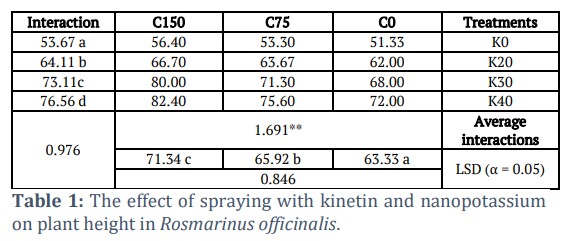
The results presented in Table 1 indicate that both nanopotassium and kinetin had significant effects on Rosmarinus officinalis plant height. Increasing nanopotassium concentration from 0 to 40 mg L⁻¹ resulted in a progressive increase in plant height, with the highest value recorded at 40 mg L⁻¹ (76.56 cm), compared to the lowest height of 53.67 cm at 0 mg L⁻¹. This finding highlights the critical role of potassium in promoting stem elongation, possibly through its involvement in cell expansion, enzyme activation, and enhanced nutrient uptake. Similar observations were reported by [11], who demonstrated that nanopotassium application improved shoot growth and water use efficiency in soybean under stress conditions.
With respect to kinetin, plant height also responded positively to increasing concentrations. The application of 150 mg L⁻¹ resulted in the greatest height (71.34 cm), while untreated plants (0 mg L⁻¹) recorded the lowest (63.33 cm). Kinetin is known to promote cell division and delay senescence, thereby supporting continuous vegetative growth. These results are consistent with findings by [12], who reported that kinetin significantly enhanced vegetative growth in globe artichoke.
The interaction between nanopotassium and kinetin was particularly pronounced. The combined treatment of 40 mg L⁻¹ nanopotassium and 150 mg L⁻¹ kinetin produced the maximum plant height (82.40 cm). The highest branching rate (11.33 branches plant⁻¹) was observed for the interaction between 40 mg L⁻¹ nanopotassium and 150 mg L⁻¹ kinetin (K40 × C150), while the individual effects of 40 mg L⁻¹ nanopotassium and 150 mg L⁻¹ kinetin resulted in average branch numbers of 9.11 and 9.25 branches plant⁻¹, respectively. This synergistic effect suggests that nanopotassium supplies the essential nutrient required for metabolic processes, while kinetin regulates growth at the hormonal level, together maximizing shoot elongation.
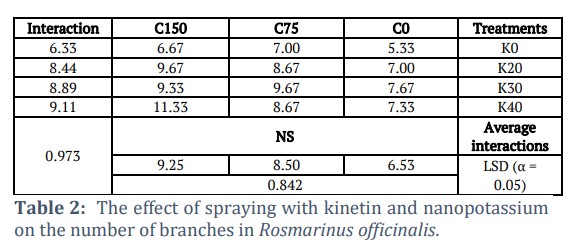
Regarding the number of branches, a similar trend was observed (Table 1). The highest branching rate (9.11 branches plant⁻¹) was obtained at 40 mg L⁻¹ nanopotassium, while the lowest (6.33 branches plant⁻¹) occurred at 0 mg L⁻¹. Likewise, kinetin at 150 mg L⁻¹ promoted the greatest branching (9.25 branches plant⁻¹), whereas untreated plants showed only 6.53 branches. This increase in branching may be attributed to the ability of kinetin to break apical dominance and stimulate lateral bud initiation, supported by adequate potassium nutrition that improves assimilate distribution. However, the interaction effect between the two factors was not statistically significant for this trait, indicating that their influence on branching was mainly additive rather than synergistic.
Overall, these results clearly demonstrate that both nanopotassium and kinetin, particularly when applied at higher concentrations, play a pivotal role in improving vegetative growth traits of Rosmarinus officinalis, including plant height and branching.
Number of branches of the plant:
The statistical analysis in Table 2 shows that both nanopotassium and kinetin significantly influenced the number of branches per Rosmarinus officinalis plant. Increasing nanopotassium concentration from 0 to 40 mg L⁻¹ led to a steady improvement in branching, with the maximum value of 9.11 branches plant⁻¹ obtained at 40 mg L⁻¹, compared with the minimum of 6.33 branches at 0 mg L⁻¹. This indicates that adequate potassium nutrition enhances shoot development, as potassium plays a fundamental role in photosynthesis, assimilate transport, and enzyme activation, all of which promote the initiation and growth of lateral shoots. Similar findings were reported by Mahdi et al. (2023), who observed that nanopotassium increased vegetative growth traits in Stevia rebaudiana.
Kinetin application also had a pronounced effect on branching. The highest mean number of branches (9.25 branches plant⁻¹) was recorded at 150 mg L⁻¹, while the lowest value (6.53 branches plant⁻¹) was observed in untreated plants. This result is consistent with the role of kinetin as a cytokinin, which stimulates cell division, delays apical dominance, and promotes lateral bud outgrowth. Comparable effects of kinetin on enhanced branching have been reported in olive and artichoke plants [1].
However, the interaction between nanopotassium and kinetin did not result in statistically significant differences, suggesting that the two factors act independently in promoting branching. In other words, while both nanopotassium and kinetin contributed positively to branch development, their combined effect was additive rather than synergistic.Taken together; these findings highlight the importance of both nanopotassium and kinetin in improving Rosmarinus officinalis branching capacity, thereby increasing the overall vegetative biomass. Enhanced branching is particularly desirable in medicinal and aromatic plants, as it contributes to higher leaf production and potentially greater accumulation of bioactive compounds.
Plant stem diameter
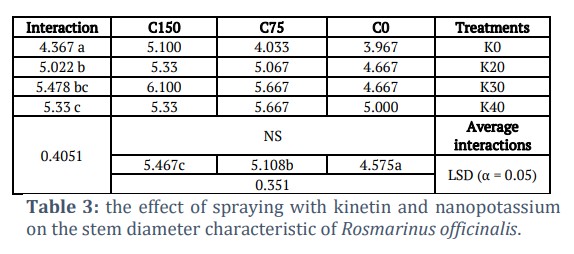
The statistical analysis in Table 3 reveals significant differences in stem diameter as affected by both nanopotassium and kinetin levels. Among the nanopotassium treatments, the concentration of 30 mg L⁻¹ produced the largest stem diameter (5.478 mm), while the lowest value (4.367 mm) was observed at 0 mg L⁻¹. This improvement can be attributed to the essential role of potassium in strengthening sclerenchyma tissues, enhancing vascular bundle formation, and facilitating assimilate translocation. Adequate potassium nutrition also stimulates ATP production, which supports the transport of photosynthates through the phloem, thereby promoting stem thickening. Similar effects of potassium on stem growth were reported by [15], who demonstrated that potassium fertilization enhanced carbon distribution and vascular development in apple rootstocks.
Kinetin application also had a clear effect on stem diameter. The highest value (5.467 mm) was obtained at 150 mg L⁻¹, whereas the untreated plants (0 mg L⁻¹) recorded the smallest diameter (4.575 mm). This result is consistent with the role of Kinetin in promoting cell division and tissue differentiation. Kinetin, by stimulating cambial activity, enhances the development of vascular tissues and secondary thickening of stems. Comparable findings were reported by [9], who noted that kinetin application improved stem robustness in citrus seedlings.
The interaction between nanopotassium and kinetin was not statistically significant, suggesting that while both factors individually enhanced stem diameter, their effects were not synergistic. Instead, each factor contributed independently to stem thickening.
Overall, these results confirm that both sufficient potassium nutrition and kinetin supplementation are important for improving stem diameter in Rosmarinus officinalis. Stronger stems are agronomically valuable because they support increased branching and leaf biomass, contributing to higher overall yield and improved resilience of the plant.
Chlorophyll content
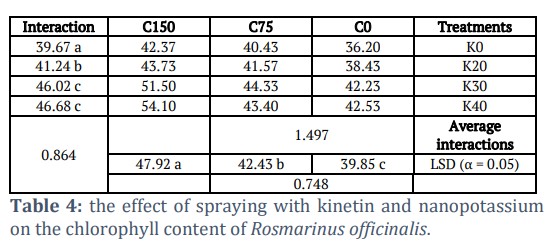
The results in Table 4 demonstrate that both nanopotassium and kinetin had significant effects on chlorophyll content in Rosmarinus officinalis leaves, with a clear interaction between the two factors. Increasing nanopotassium concentration from 0 to 40 mg L⁻¹ resulted in a steady rise in chlorophyll levels, from a minimum of 39.67 SPAD units at 0 mg L⁻¹ to a maximum of 46.68 SPAD units at 40 mg L⁻¹. This increase can be attributed to the role of potassium in improving nutrient uptake efficiency and sustaining nutrient availability over longer periods. By regulating stomatal function and enhancing enzymatic activity, potassium supports chlorophyll biosynthesis and reduces degradation. Similar findings were reported by [11], who confirmed that potassium fertilization enhanced chlorophyll content and photosynthetic efficiency in soybean.
Kinetin also showed a strong positive influence, with the highest chlorophyll content (47.92 SPAD units) observed at 150 mg L⁻¹, while untreated plants recorded the lowest value (39.85 SPAD units). As a cytokinin, kinetin delays leaf senescence, stimulates chloroplast differentiation, and enhances photosynthetic pigment accumulation, thereby improving the plant’s photosynthetic capacity. Comparable results were noted by [2], who reported increased chlorophyll levels in olive trees following kinetin application.
Importantly, the interaction between the two factors was statistically significant. The combined treatment of 40 mg L⁻¹ nanopotassium with 150 mg L⁻¹ kinetin produced the highest chlorophyll concentration (54.10 SPAD units), markedly higher than either factor alone. This synergistic effect reflects the complementary roles of potassium as a macronutrient facilitating metabolic processes, and kinetin as a growth regulator enhancing chloroplast activity and leaf expansion.
Nitrogen rate in leaves
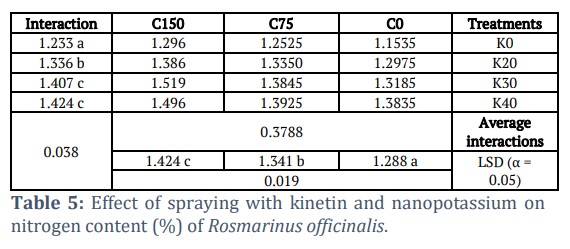
The findings presented in Table 5 show clear and significant effects of both nanopotassium and kinetin on nitrogen accumulation in Rosmarinus officinalis leaves. Among the nanopotassium treatments, the concentration of 40 mg L⁻¹ recorded the highest nitrogen content (1.4240 %), followed closely by 30 mg L⁻¹ (1.4072 %), whereas the lowest value (1.2338 %) was obtained at 0 mg L⁻¹. These results highlight the essential role of potassium in enhancing nitrogen assimilation and metabolism. Potassium regulates enzymatic activity and supports nitrate reduction, thereby facilitating more efficient incorporation of nitrogen into plant tissues. Similar outcomes were reported by [16], who demonstrated that potassium supplementation significantly improved nitrogen utilization in apple trees.
Kinetin application also exhibited a marked influence. The treatment with 150 mg L⁻¹ kinetin resulted in the highest nitrogen concentration (1.4240 %), whereas the untreated control showed the lowest value (1.2882 %). This can be explained by kinetin’s role in enhancing nutrient mobility and distribution within plant tissues. As a cytokinin, kinetin stimulates the remobilization of nutrients, particularly nitrogen, between older and younger leaves, which maintains higher levels of metabolic activity and delays senescence. Similar results were observed by [9], who reported that kinetin improved nitrogen translocation and retention in citrus seedlings.
Importantly, the interaction between the two factors was statistically significant. The combination of 30 mg L⁻¹ nanopotassium with 150 mg L⁻¹ kinetin produced the maximum nitrogen content (1.5185%), while the lowest value (1.1535%) was recorded in the untreated control (0 mg L⁻¹ nanopotassium × 0 mg L⁻¹ kinetin). This indicates a synergistic relationship, where nanopotassium ensures nutrient availability and kinetin enhances its transport and utilization within the plant.
Overall, these results demonstrate that both nanopotassium and kinetin play complementary roles in improving nitrogen metabolism in Rosmarinus officinalis. Adequate potassium supply boosts nitrogen uptake efficiency, while kinetin ensures its effective redistribution within the plant. Together, they optimize vegetative growth and may contribute to higher biomass and secondary metabolite production in medicinal plants.
Figures & Tables
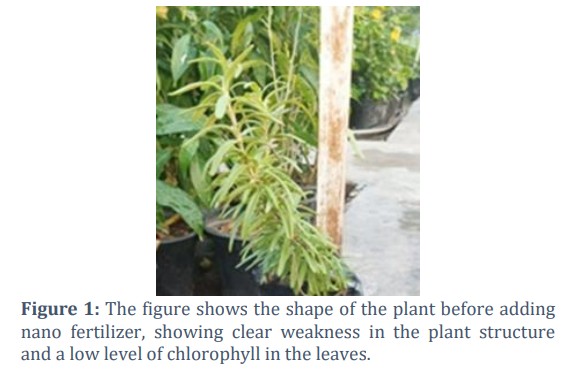
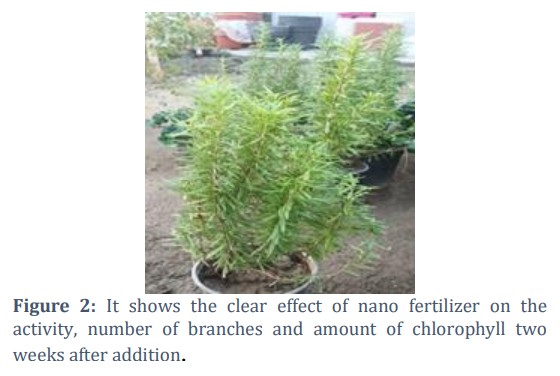
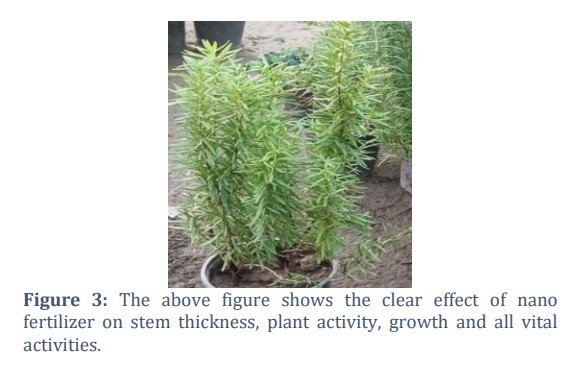
The present study clearly demonstrates that both nanopotassium and kinetin exert significant effects on the vegetative growth and physiological traits of Rosmarinus officinalis. The application of nanopotassium enhanced plant height, stem diameter, branch number, chlorophyll concentration, and nitrogen content, with the most pronounced effects generally observed at higher concentrations (30–40 mg L⁻¹). These findings are consistent with the fundamental role of potassium in regulating enzymatic activity, nutrient uptake, and photosynthate transport, all of which are crucial for sustaining vigorous vegetative development. Similar results were reported by [11], who confirmed that nanopotassium application improved growth and water use efficiency in soybean under field conditions.
Kinetin also showed a strong and consistent influence on Rosmarinus officinalis growth parameters. The highest concentration (150 mg L⁻¹) significantly improved plant height, branching, stem thickness, chlorophyll content, and nitrogen assimilation compared with untreated plants. This aligns with the well-established role of Kinetin in promoting cell division, stimulating lateral bud outgrowth, delaying senescence, and enhancing chloroplast differentiation. Comparable findings have been reported in several crops, including olive [2] and globe artichoke [1], where kinetin markedly enhanced vegetative growth and physiological performance.
Interestingly, while both factors acted independently to improve most traits, their combined application often produced superior results. The interaction between nanopotassium and kinetin was particularly evident in plant height, chlorophyll concentration, and nitrogen content, where the combination of 30 mg L⁻¹ nanopotassium and 150 mg L⁻¹ kinetin produced the highest values (1.5185%, respectively). This suggests a synergistic effect in which potassium ensures nutrient availability while kinetin enhances their utilization and redistribution within the plant. Such synergy is critical in maximizing biomass production and the accumulation of bioactive compounds in medicinal plants.
Overall, the results highlight the potential of integrating nanotechnology-based fertilizers with plant growth regulators to promote sustainable agriculture. Nanopotassium improves nutrient use efficiency by providing a controlled release of potassium, while kinetin optimizes the physiological processes that translate these nutrients into growth. Together, these treatments represent an effective and environmentally friendly strategy to enhance Rosmarinus officinalis productivity and quality. Future research should explore the long-term effects of such combined applications on secondary metabolite synthesis and field-scale cultivation, which would further establish their agronomic and commercial value.
Zainab Abdel Rahim Najm: Conceptualization, methodology, investigation, and writing – original draft preparation.
Omar Hazem Al-Rawi: Data curation, formal analysis, and writing – review and editing.
Mustafa R AL-Shaheen: Supervision, project administration, and funding acquisition.
References
- Abouelsaad IA, Abd-Elkade DY, SH Breng. The combined effects of gibberellic acid and kinetin on growth, yield, and quality in globe artichoke (Cynara scolymus L.). Fayoum Journal of Agricultural Research and Development, (2023); 37(1): 82–97.
- Al-Isaw NAM, Al-Janabi AMI. Effect of foliar application with kinetin and amino acids on the vegetative growth and chemical content of young olive trees cv. "K18". Annals of the Romanian Society for Cell Biology, (2021): 10067–10076.
- Hassan, Z. A., Hamad, H. S., & AL-shaheen, M. R. (2018, December). Determination antimicrobial activity of leaves extracted by various solvents from (Elephantopus scaber L.). In IOP Conference Series: Materials Science and Engineering (Vol. 454, No. 1, p. 012110). IOP Publishing..
- , Zakaria, Z., & Al-Shaheen, M. R. (2022, October). A review about the bioactivity of a stevia extract to inhibit the effectiveness of some types of UTI bacteria. In AIP Conference Proceedings (Vol. 2400, No. 1, p. 030007). AIP Publishing LLC..
- Azameti MK, Imoro A-WM. Nanotechnology: A promising field in enhancing abiotic stress tolerance in plants. Crop Design, (2023); 2(2): 100037.
- Elsayed AA, Ahmed EG, Taha ZK, Farag HM, Hussein MS, et al. Hydroxyapatite nanoparticles as novel nano-fertilizer for production of Rosmarinus officinalis plants. Scientia Horticulturae, (2022); 295: 110851.
- Mahawish A, Bouazza A, Gates WP. Unconfined compressive strength and visualization of the microstructure of coarse sand subjected to different biocementation levels. Journal of Geotechnical and Geoenvironmental Engineering, (2019); 145(8): 04019033.
- Mahdi AN, Al-Janabi AMI, Mahmood AH. Effect of spraying with amino acids (tryptophan and glycine) and nano-potassium on some vegetative growth characteristics of Stevia plant (Stevia rebaudiana Bertoni). IOP Conference Series: Earth and Environmental Science, (2023).
- Mahmoud TA, Abo-Eid MA, Khodier MA. Effect of spraying some growth regulators on the vegetative growth of Cleopatra mandarin seedlings. Egyptian Journal of Agricultural Research, (2023); 101(1): 236–243.
- Mirzaeian R, Sadoughi F, Tahmasebian S, Mojahedi M. The role of herbal medicines in healthcare quality and the related challenges. Journal of Herbmed Pharmacology, (2021); 10(2): 156–165.
- Rostami Ajirloo AA, Amiri E. Effects of nano-potassium fertilizer on yield and water use efficiency of soybean under water deficit conditions (case study: Moghan plain, Iran). Communications in Soil Science and Plant Analysis, (2022); 53(12): 1542–1551.
- Rozov A, Khusainov I, El Omari K, Duman R, Mykhaylyk V,, et al. Importance of potassium ions for ribosome structure and function revealed by long-wavelength X-ray diffraction. Nature Communications, (2019); 10(1): 2519.
- Sakar EH, Zeroual A, Kasrati A, Gharby S. Combined effects of domestication and extraction technique on essential oil yield, chemical profiling, and antioxidant and antimicrobial activities of Rosmarinus officinalis (Rosmarinus officinalis L.). Journal of Food Biochemistry, (2023); 2023(1):6308773.
- Singh N, Dhillon A, Nemiwal M, Kumar D. Metal−Organic frameworks for water decontamination and reuse: a dig at heavy metal ions and organic toxins. In: Metal−Organic Frameworks for Environmental Remediation. ACS Publications; (2021): 77–124.
- Xu X, Du X, Wang F, Sha J, Chen Q, Tian G, et al. Effects of potassium levels on plant growth, accumulation, and distribution of carbon, and nitrate metabolism in apple dwarf rootstock seedlings. Frontiers in Plant Science, (2020); 11: 904.
- Ye X, Abe S, Zhang S. Estimation and mapping of nitrogen content in apple trees at leaf and canopy levels using hyperspectral imaging. Precision Agriculture, (2020); 21:198–225.
This work is licensed under a Creative Commons Attribution-Non Commercial 4.0 International License. To read the copy of this license please visit: https://creativecommons.org/licenses/by-nc/4.0