Full Length Research Article
Protective Efficacy of Phoenix dactylifera Pollen Aqueous Extract Against Male Rat Infertility Caused by Lead
Zainab A. Shehab, Huda K. Khassaf*, Rashad Fadhil Ghadhban
Adv. life sci., vol. 12, no. 3, pp. 498-502, August 2025
*- Corresponding Author: Huda K. Khassaf (Email: Huda.khassaf@uobasrah.edu.iq)
Authors' Affiliations
[Date Received: 13/12/2024; Date Revised: 08/02/2025; Available Online: 31/10/2025]
Abstract
Introduction
Methods
Results
Discussion
References
Abstract
Background: Lead produces excessive reactive oxygen species (ROS) and accelerates lipid peroxidation. A wide range of tropical plants and their extracts, including fertility-boosting compounds and antioxidants, have demonstrated significant therapeutic benefits. One of the promising therapeutic plants is Phoenix dactylifera pollen, which is a tropical and subtropical tree. It is rich in flavonoids, phenolics, antioxidants, ferulic, p-coumaric, and sinapic acids.
Methods: Thirty-two male rats were studied and divided into four groups: (1) control (normal saline), (2) lead acetate exposure (80 mg/kg) group, (3) date palm pollen treatment (300 mg/kg) group, and (4) lead exposure + date palm pollen treatment group. After 30 days, organ weights (liver, testes, kidneys, spleen) and sperm health (count, motility, viability) were compared.
Results: In lead-exposed rats, improvements were noted in the mass of liver, testes, kidneys, and spleen after treatment with P. dactylifera extracts. The results also showed a noteworthy surge in testicular weight as contrasted with the lead-treated group. Furthermore, rats treated with both lead and Phoenix dactylifera pollen extract showed a significant increase in sperm count (106/mm3), motility, and live sperm percentage, along with a decrease in dead sperm percentage, compared to the group treated with lead alone.
Conclusion: It appears that date palm pollen of P. dactylifera serves as a potentially effective remedy for male infertility. Data showed antioxidant effects of aqueous pollen extract from P. dactylifera in ameliorating the toxic effect of lead on testes and weight of organs by improvements in fertility parameters as compared to the lead-treated group.
Keywords: Phoenix dactylifera, Pollen, Sperm, Testes, Lead
Introduction
According to reports, environmental contamination endangers animal health and reduces productivity [1]. Scientists are increasingly concerned about the harmful effects of metal pollution in the environment, and extensive research has been conducted globally [2]. There is growing worry about environmental pollutants entering the systems used to produce livestock because the effects of toxic metal pollution on animals result in significant economic losses [3]. Pollutants in the environment and industry frequently contain lead. Industrial pollutants, soil, car exhaust gases, and contaminated crops like spinach and cabbage are often cultivated near lead sources. These may contain elevated amounts of lead and are the main sources of lead exposure [4]. Lead is used to make rust-proof paint, alloys, cable sheathing, lead-acid batteries, and pigments [5]. Lead is known to increase lipid peroxidation and cause an excess of reactive oxygen species (ROS) [6]. Moreover, nuclear factor E2-related factor Nrf2, which is closely associated with antioxidant response components, is a key regulator of the cellular oxidative stress response [7]. Lead may prevent the development of spermatocytes, immature spermatids, and mature spermatids [8]. A greater variety of tropical plants and their extracts have demonstrated significant medicinal effects, including chemicals that increase fertility as well as antimicrobial, aphrodisiac, antioxidant, anti-inflammatory, and anti-cancer properties [9]. The application of herbal remedies has grown in popularity across the globe, particularly in Asian and African nations. Traditional medicine uses a variety of P. dactylifera plant parts extensively to treat a variety of ailments, such as neurological disorders, fever, inflammation, paralysis, coma, and memory issues [10-12]. The extent of the biologic activities of this widely used botanical medicine has to be evaluated in light of the issues over male animal infertility in our cattle business. P. dactylifera pollen is one of the promising medicinal plants. Phytochemicals such as phenolics, sterols, carotenoids, anthocyanins, procyanidins, and flavonoids are said to be abundant in date fruit pulp [13-15]. According to certain theories, date fruit may help prevent cellular death because of these inherent phyto-constituents [16,17]. The use of herbal remedies is growing, and two of them are currently being researched to determine the scientific basis for their therapeutic effects [18]. P. dactylifera is a species that originated in the Middle East many years ago [19,20]. Date palm pollen (DPP) suspension is a common folk remedy in traditional medicine for treating male infertility, together with phenolic diterpenes, anthocyanins, procyanidins, and coumaric acid. Date seeds have been shown to have high nutritional benefits in studies, especially regarding their antioxidant and fiber levels [21,22]. Date seeds contain a variety of chemical substances, including protein, fat, dietary fiber, zinc (Zn), calcium (Ca), potassium, and unsaturated fatty acids that may impede the 5-reductase enzyme, such as oleic and linoleic acids [23,24]. Moreover, seeds are rich in phenolics, antioxidants, flavonoids, procyanidins, p-coumaric, ferulic, and sinapic acids, and lipids, which can be wax, fat, or oil [25,26]. Traditional medicine practitioners frequently employ the herbal mixture suspension of DPP to treat male infertility. Date palm fruit suspensions boost testicular and epididymal weights while enhancing sperm motility, morphology, and DNA quality [27].
Methods
Plant material
Plant samples were obtained from the Shatt Al Arab Botanical Park, Basra, Iraq. Using an affine gauze sieve, the pollen was removed from the kernels and stored in the refrigerator at 4°C. Powdered pollen was mixed with distilled water using a magnetic stirrer for ten minutes to ensure complete dispersion. The aqueous suspension was prepared fresh daily.
Study Design
In this investigation, 32 mature male albino rats weighing between 200 and 210 grams were employed. The experiment was carried out in the Veterinary Medicine Student Animal Building at the University of Basrah. Throughout the trial, rats were housed in clean, well-ventilated polypropylene cages with adequate food and water. At least two weeks prior to the commencement of the study, they were accustomed to the lab environment. Rats in this investigation were split into four test groups.
Group I:
Served as a control and administered 0.1 ml of N.S. for 30 days.
Group II:
Rats received lead acetate (80 mg/kg body weight) only through intraperitoneal injection for 30 days.
Group III:
Rats received aqueous extract of pollen, only 300 mg/kg orally for 30 days.
Group IV:
Rats received lead acetate (80 mg/kg) via intraperitoneal injection and aqueous extract of Phoenix dactylifera pollen (300 mg/kg) for 30 days. Rats received lead acetate (80 mg/kg body weight) through intraperitoneal injection, and after one hour, received aqueous extract of pollen 300 mg/kg orally for 30 days.
Rats were euthanized humanely under general anesthesia in accordance with the institutional animal ethics committee guidelines. The organs (testes, liver, kidney, and spleen) of all animals were weighed, and the number of sperm was calculated using the hemocytometers, utilizing Majumder and Biswas' methodology [24].
Statistical Analysis
Data expressed as Mean ± SEM was analyzed, and two-way ANOVA was used to evaluate the data. It was performed to compare the means of each experimental group and the control group; A p-value < 0.05 was considered significant, and SPSS software version 17.0 was used for analysis.
Results
From the results in Table 1, when animals were treated with lead acetate only, there was a significant increase in the weight of liver, kidney, and spleen, but a significant decrease was observed in testicular weight between the lead-treated group and the control group. On the other hand, when the animals were treated with lead and aqueous extract of P. dactylifera pollen, there was a notable decline in the weight of liver and kidney as compared with the lead-treated group only, and these organs’ weight shifted towards the normal values recorded in the control group animals. Concerning testes weight, the group treated with both lead and the extract showed a significant improvement, with the weight shifting towards that recorded in the control group animals.
It is evident from Table 2 that the semen viability (sperm count (106/mm3), live and dead sperm) of animals treated with the aqueous extract of plant pollen shows approximately normal levels, while sperm motility is significantly decreased compared with the control group. Also from Table 2, it can be observed that the reproductive parameters declined when animals were exposed to toxic material (lead treatment), while the percentage of dead sperm increased as compared to the control group.
Figures & Tables
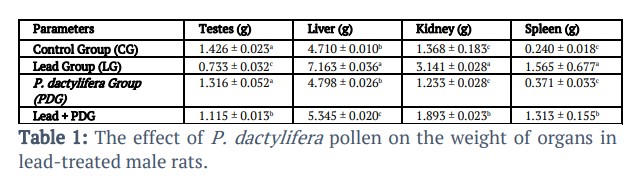
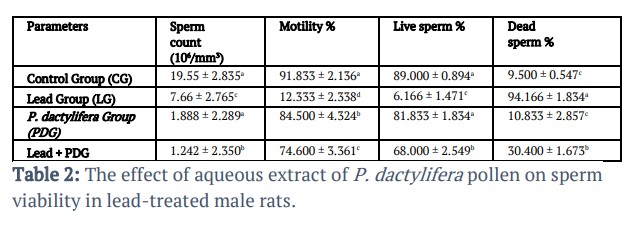
The findings of this study revealed that lead significantly (p < 0.05) reduced the weights of the testes, sperm viability, and the number of live sperm, while it increased the weights of the liver, kidneys, and spleen compared to the control group. After undergoing aqueous extract therapy of the plant pollen for 30 days, these values in the lead-exposed rats group showed significant improvement, shifting towards the control group. P. dactylifera pollen contains a phytochemical that has a calming effect. For instance, it is thought that the saponin present in P. dactylifera pollen helped to cause the reported rise in sperm motility. The highest percentage of sperm motility was seen in the group that was given 300 mg/kg body weight, the highest dosage. This rise in sperm motility was detected with high doses of saponin extract. This could have been accomplished by raising internal cAMP, which is observed to be responsive to lead toxicity and plays a role in sperm kinematics, by inhibiting the cAMP phosphodiesterase using saponins in aqueous extract. Hence, therapies that raise intracellular cAMP levels also raise kinematics and sperm motility [28]. Also, it is likely that the phytochemicals in the plant directly benefited the testes through direct therapeutic effects. According to Roberts et al., [29], dates contain flavonoids and estradiol, which improve sperm health and boost male reproductive activity. P. dactylifera has gonadotrophin-like actions, which may be caused by its steroidal components, according to a report by Eustache et al., [30]. The phytochemical genistein from dates and plant-derived compounds has the potential to enhance sex and is used to treat sexual dysfunction [31,32]. These phytochemicals stimulate sexual arousal, desire, and enjoyment during sexual activity [28]. The male sexual function is facilitated by P. dactylifera according to analysis. DPP has a high concentration of sterols, steroids, alkaloids, and flavonoids, all of which have the ability to enhance and control sexual behavior [33]. Given that the DPP’s flavonoid components change testosterone levels, it could make sense to link these behaviors to them. DPP’s alkaloid concentration seems to have ergogenic qualities by causing blood vessel vasodilation, which occurs during an erection. They can alter the production of neurotransmitters and receptor expression in brain regions involved in sexual arousal and regulation, enhance the processing of sensory stimuli, and increase responsiveness through genomically mediated actions [34-36]. Like our findings, other studies have demonstrated that when compared to the control, segments of the Quassinoid-rich Eurycoma longifolia extract and pomegranate juice dramatically boosted the concentration and motility of epididymal sperm, the density of spermatogenic cells, and reduced the rate of aberrant sperm [37]. The tests showed increased secretions after giving the animals DPP. This observation is consistent with other studies where doses of 120 mg/kg and 240 mg/kg were administered. This boosted activity was reflected in their higher testosterone and estradiol levels, which might explain why the relative weights of their tests and epididymides increased compared to their overall body weight [38]. Findings of the current study were in line with those of a study by Abedi et al., [39], which found that taking Bulbine natalensis Baker stem extract at doses of 25 and 50 mg/kg increased testicular weight. These findings support the traditional use of P. dactylifera as an aphrodisiac and a remedy for premature ejaculation [40]. The available information points to its use in treating sexual dysfunction and its effects on sexual desire. The presence of steroids, alkaloids, and flavonoids may cause P. dactylifera pollen effects through a variety of cerebral and peripheral pathways [40].
Acknowledgement
The authors sincerely thank the faculty and staff of Basrah University College of Veterinary Medicine, as well as the staff of the animal home, for their assistance and support.
Author Contributions
All of the authors contributed to the work that is being presented here. Each author has contributed to the study's conception and design, the gathering of data, the analysis and interpretation of the findings, and the report's composition. The writers are grateful for their assistance and encouragement.
No conflicts of interest have been disclosed by the writers.
References
- Galadima A, Garba ZN, Leke L, Almustapha MN, Adam IK. Domestic water pollution among local communities in Nigeria – Causes and consequences. European Journal of Scientific Research, (2011); 52(4): 592-603.
- Shi J, Wang H, Xu J, Wu J, Liu X, et al. Spatial distribution of heavy metals in soils a case study of Changxing, China. Environmental Geology, (2007); 52(2007): 1-10.
- Amara S, Abdelmelek H, Garrel C, Guiraud P, Douki T, et al. Preventive effect of zinc against cadmium- induced oxidative stress in rat testis. Journal of Reproduction and Development, (2008); 54(2): 129-134.
- Khanna P. Assessment of heavy metal contamination in different vegetables grown in and around urban areas. Research Journal of Environmental Toxicology, (2011); 5(3): 162-179.
- Patra RC, Rautray AK, Swarup D. Oxidative stress in lead and cadmium toxicity and its amelioration. Veterinary Medicine International, (2011); 2011(1): 1-9.
- Gama EM, da Silva Lima A, Lemos VA. Preconcentration system for cadmium and lead determination in environmental samples using polyurethane foam/Me-BTANC. Journal of Hazardous Materials, (2006); 136(3): 757–762.
- Quinn MJ, Sherlock JC. The correspondence between UK ‘action levels’ for lead in blood and in water. Food Additional Contamination, (1999); 7(3): 387-424.
- Malecka A, Jarmuszkiewicz W, Tomaszewska B. Antioxidative defense to lead stress in subcellular compartments of pea root cells. Acta Biochimica Polonica, (2001); 48(3): 687-698.
- Kobayashi A, Kang MI, Watai Y, Tong KI, Shibata T, et al. Oxidative and electrophilic stresses activate Nrf2 through inhibition of ubiquitination activity of Keap1. Molecular and Cellular Biology, (2006); 26(1): 221-229.
- Kaushal D, Bansal MR, Bansal MP. Cell kinetics of the rat seminiferous epithelium following lead acetate treatment. The Journal of Trace Elements in Experimental Medicine: The Official Publication of the International Society for Trace Element Research in Humans, (1996); 9(2): 47-56.
- Petrovska BB. Historical review of medicinal plants’ usage. Pharmacognosy reviews, (2012); 6(11): 1.
- Al-Daihan S, Bhat RS. Antibacterial activities of extracts of leaf, fruit, seed and bark of Phoenix dactylifera. African Journal of Biotechnology, (2012); 11(42): 10021-10025.
- Saafi EB, Louedi M, Elfeki A, Zakhama A, Najjar MF, et al. Protective effect of date palm fruit extract (Phoenix dactylifera L.) on dimethoate induced-oxidative stress in rat liver. Experimental and Toxicologic Pathology, (2011); 63(5): 433-441.
- Adaay MH, Mattar AG. Effect of aqueous and ethanolic extracts of Tribulus terrestris, Phoenix dactylifera and Nasturtium officinale mixture on some reproductive parameters in male mice. Baghdad Science Journal, (2012); 9(4): 640-650.
- Khare CP. Indian medicinal plants: an illustrated dictionary. 2008. Springer Science & Business Media
- El‐Neweshy MS, El‐Maddawy ZK, El‐Sayed YS. Therapeutic effects of date palm (Phoenix dactylifera L.) pollen extract on cadmium‐induced testicular toxicity. Andrologia, (2013); 45(6): 369-378.
- Bahmanpour S, Kavoosi F, Talaei T, Panjehshahin MR. Effects of date palm (Phoenix dactylifera) gemmule extract on morphometric parameters of reproductive tissues, hormones and sperm quality in rat. Anatomical Sciences Journal, (2013); 10(3): 144-150.
- Al-Farsi M, Alasalvar C, Al-Abid M, Al-Shoaily K, Al-Amry M, et al. Compositional and functional characteristics of dates, syrups, and their by-products. Food chemistry, (2007); 104(3): 943–947.
- Habib HM, Ibrahim WH. Nutritional quality evaluation of eighteen date pit varieties. International journal of food sciences and nutrition, (2008); 60(sup1): 99-111.
- Shariati M, Sharifi E, Kaveh M. The effect of Phoenix dactylifera (date-palm) pit powder on testosterone level and germ cells in adult male rats. Journal of Advances in Medical and Biomedical Research, (2007); 15(61): 21-28.
- Gu L, Kelm MA, Hammerstone JF, Beecher G, Holden J, et al. Screening of foods containing proanthocyanidins and their structural characterization using LC-MS/MS and thiolytic degradation. Journal of Agricultural and Food Chemistry, (2003); 51(25): 7513-7521.
- Afiq MA, Rahman RA, Man YC, Al-Kahtani HA, Mansor TS. Date seed and date seed oil. International Food Research Journal, (2013); 20(5): 2035-2043.
- Hassan WA, El-kashlan AM, Mohamed NA. Egyptian date palm pollen ameliorates testicular dysfunction induced by cadmium chloride in adult male rats. Journal of American Sciences, (2012); 8(4): 659-669.
- Majumder GC, Biswas R. Evidence for the occurrence of an ecto-(adenosine triphosphatase) in rat epididymal spermatozoa. Biochemical Journal, (1979); 183(3): 737-743.
- Oyeyemi MO, Soetan KO, Akinpelu OB. Sperm characteristics and haemogram of male albino rats (wistar strain) treated with saponin extract from Vernonia amygdalina del. asteraeceae 110192. Journal of Cell and Animal Biology, (2015); 9(3): 26-30.
- Henkel RR, Schill WB. Sperm preparation for ART. Reproductive Biology and Endocrinology, (2003); 1(2003): 1-22.
- El-Kott AF, Sayed AA, El-Sayad SM, Abdoulrahman MH. The pharmaceutical effect of date palm fruit extract (Phoenix dactylifera L.) against amitraz-induced infertility in male rats. Advances in Life Science and Technology, (2014); 22(2014): 14-26.
- Bahmanpour S, Panjeh SM, Talaei T, Vojdani Z, Poust PA, et al. Effects of Phoenix dactylifera pollen on sperm parameters and reproductive system of adult male rats. Iranian Journal of Medical Sciences, (2006); 31(4): 208-212.
- Roberts D, Veeramachaneni DR, Schlaff WD, Awoniyi CA. Effects of chronic dietary exposure to genistein, a phytoestrogen, during various stages of development on reproductive hormones and spermatogenesis in rats. Endocrine, (2000); 3(2000): 281-286.
- Eustache F, Mondon F, Canivenc-Lavier MC, Lesaffre C, Fulla Y, et al. Chronic dietary exposure to a low-dose mixture of genistein and vinclozolin modifies the reproductive axis, testis transcriptome, and fertility. Environmental Health Perspectives, (2009); 117(18): 1272-1279.
- Cicero AF, Bandieri E, Arletti R. Lepidium meyenii Walp. improves sexual behaviour in male rats independently from its action on spontaneous locomotor activity. Journal of Ethnopharmacology, (2001); 75(2-3): 225– 229.
- Adimoelja A. Phytochemicals and the breakthrough of traditional herbs in the management of sexual dysfunctions. International Journal of Andrology, (2000); 23(S2): 82–84.
- Biglari F, AlKarkhi AF, Easa AM. Antioxidant activity and phenolic content of various date palm (Phoenix dactylifera) fruits from Iran. Food Chemistry, (2008); 107(4): 1636–1641.
- Al-Qarawi AA, Mousa HM, Ali BH, Abdel-Rahman H, El-Mougy SA. Protective effect of extracts from dates (Phoenix dactylifera L.) on carbon tetrachloride-induced hepatotoxicity in rats. International Journal of Applied Research in Veterinary Medicine, (2004); 2(3): 176-180.
- Türk G, Sönmez M, Aydin M, Yüce A, Gür S, et al. Effects of pomegranate juice consumption on sperm quality, spermatogenic cell density, antioxidant activity and testosterone level in male rats. Clinical Nutrition, (2008); 27(2): 289-296.
- Low BS, Das PK, Chan KL. Standardized quassinoid-rich Eurycoma longifolia extract improved spermatogenesis and fertility in male rats via the hypothalamic–pituitary–gonadal axis. Journal of Ethnopharmacology, (2013); 145(3): 706-714.
- Elberry AA, Mufti ST, Al-Maghrabi JA, Abdel-Sattar EA, Ashour OM, et al. Anti-inflammatory and antiproliferative activities of date palm pollen (Phoenix dactylifera) on experimentally-induced atypical prostatic hyperplasia in rats. Journal of Inflammation, (2011); 8(2011): 1-13.
- Yakubu MT, Afolayan AJ. Reproductive toxicologic evaluations of Bulbine natalensis Baker stem extract in albino rats. Theriogenology, (2009); 72(3): 322-332.
- Abedi A, Parviz M, Karimian SM, Rodsari HR. Aphrodisiac activity of aqueous extract of Phoenix dactylifera pollen in male rats. Advances in Sexual Medicine, (2013); 3(1): 28-34.
- Padashetty SA, Mishra SH. Aphrodisiac studies of Tricholepis glaberrima. With supportive action from antioxidant enzymes. Pharmaceutical Biology, (2007); 45(7): 580-586.
This work is licensed under a Creative Commons Attribution-Non Commercial 4.0 International License. To read the copy of this license please visit: https://creativecommons.org/licenses/by-nc/4.0